Our Top Picks
- The Powerhouse: An 8.3L V10 from a 2004 Ram SRT10 producing 500hp and a monstrous 525 lb-ft of torque.
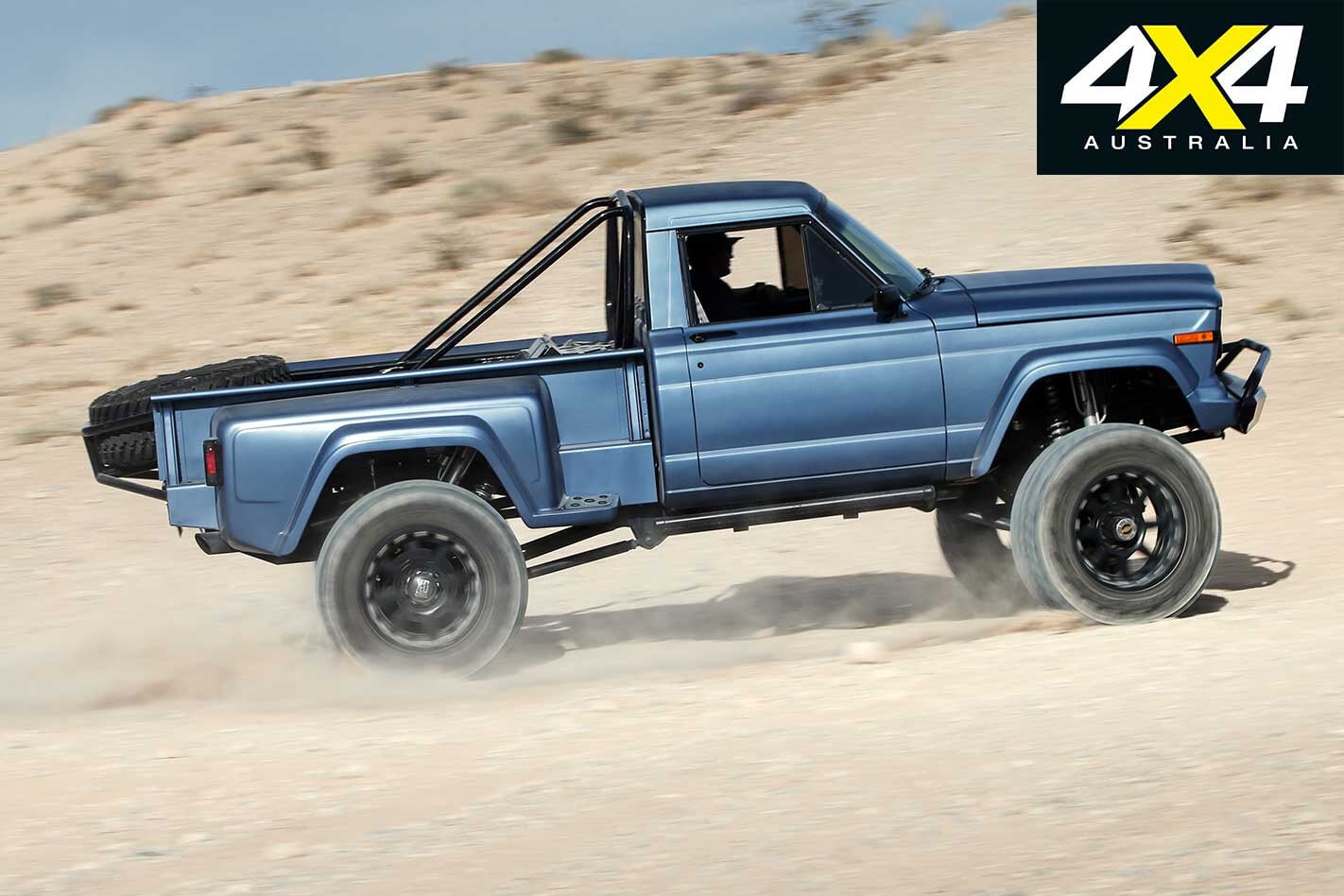
- The Stance: A menacing profile achieved via 37-inch Nitto Mud Grapplers mounted on heavy-duty 1-ton axles.
- The Engineering: Expert chassis fabrication by Nefarious Kustoms in Las Vegas, featuring a custom DOM tube back-half.
- The Aesthetic: A stunning Opal Blue Metallic finish with a matte clearcoat, complemented by a classic Rhino grille conversion.
The 1984 Jeep J10 was never meant to handle 500 horsepower, but this wicked 'Viperceptor' build changes everything with a massive 8.3L V10 engine swap. Built by Nefarious Kustoms, this truck blends classic FSJ styling with modern SRT10 power. This Jeep J10 utilizes an 8.3L V10 engine sourced from a 2004 Dodge Ram SRT10, delivering 500 horsepower through a 48RE transmission and 1-ton axles.
The V10 Heart: Sourcing and Integration
There is something inherently visceral about the sound of a dodge viper engine v10 coming to life. While the Jeep J10 originally left the factory with a modest AMC powerplant, the team at Nefarious Kustoms decided that the only proper way to honor this full-size Jeep (FSJ) was to double the cylinder count and quadruple the output. The donor for this project was a 2004 Dodge Ram SRT10, a truck that famously borrowed the Viper's aluminum-block heart to create a world-record-breaking pickup.
Integrating an 8.3L V10 engine swap into a frame designed for the 1980s is no small feat of engineering. The primary hurdle with a dodge viper engine swap in a 4x4 application is often the physical dimensions of the block. At nearly 3 feet long, the V10 requires significant firewall surgery to maintain proper weight distribution. Furthermore, the SRT10 donor engine features a relatively flat oil pan, which necessitated careful positioning to clear the front axle housing during full suspension compression.
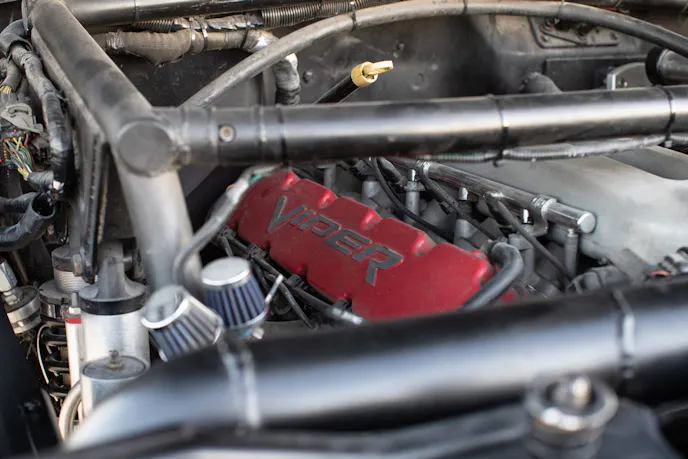
To ensure the engine breathes as well as it looks, the builders installed a custom dual-filter intake system that draws cool air from behind the Rhino grille. The exhaust note is equally impressive, managed by custom long-tube headers that dump into a high-flow Magnaflow exhaust system. This setup doesn't just sound like a supercar; it provides the 500 horsepower and 525 lb-ft of torque necessary to move this heavy-duty restomod across desert terrain with terrifying ease.
Cooling a Desert Monster
Viper engines are notorious for generating immense heat, especially when pushed in off-road environments. A traditional front-mounted radiator simply couldn't provide enough surface area without compromising the truck’s classic aesthetic. The solution was a bed-mounted radiator setup. This custom crossflow radiator utilizes dual electric fans to pull air from the bed area, ensuring the V10 stays within its optimal operating temperature even when the mercury rises in the Nevada desert. This is a critical component for any successful Viper V10 engine swap cooling solutions strategy.
Drivetrain Strength: 48RE and 1-Ton Axles
When you are dealing with 525 lb-ft of torque, the stock Jeep drivetrain becomes a collection of fuses waiting to blow. To bridge the gap between the Viper V10 engine swap and the dirt, Nefarious Kustoms looked back to the Ram SRT10 donor for the 48RE transmission. This four-speed automatic transmission was originally designed to handle the torque of Cummins diesel engines and Viper V10s alike.
The 48RE Transmission
The 48RE used in this build isn't exactly stock. It features a billet torque converter and internal upgrades to ensure crisp shifts under heavy load. The transmission is mated to an NP273 transfer case, a shift-on-the-fly unit that provides the 4WD capabilities required for a Viper V10 swap into 4x4 truck. This combination offers a blend of highway cruise-ability and low-range grunt that makes the J10 surprisingly versatile.
1-Ton Axle Hardware
To support the massive Nitto Mud Grapplers and the stresses of high-speed desert running, the truck was upgraded with a "1-ton" drivetrain. In the front, a high-pinion Dana 60 axle provides the necessary strength, while the rear features a Ford 10.25-inch axle. Both ends are fitted with 4.56 Yukon gears, a ratio perfectly chosen to keep the V10 in its powerband despite the large tire diameter. For maximum traction in the soft stuff, a Detroit Locker was installed in the rear, ensuring both wheels churn through the silt.
| Feature | Stock 1984 Jeep J10 | The 'Viperceptor' J10 |
|---|---|---|
| Engine | 4.2L I6 or 5.9L V8 | 8.3L Viper V10 |
| Horsepower | ~112 - 175 hp | 500 hp |
| Torque | ~210 - 280 lb-ft | 525 lb-ft |
| Transmission | 3-Speed Auto / 4-Speed Manual | 48RE 4-Speed Auto |
| Front Axle | Dana 44 | Dana 60 (High Pinion) |
| Rear Axle | AMC 20 / Dana 44 | Ford 10.25-inch |
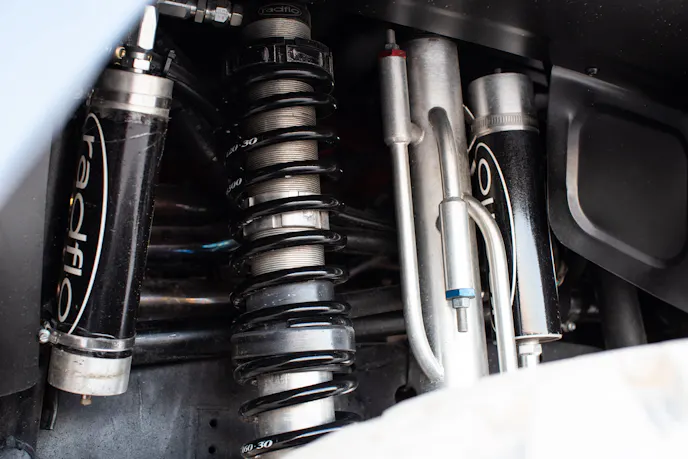
| Suspension | Leaf Springs | Radflo Coilovers/Bypass |
Desert Suspension: Radflo and 4-Link Setup
This isn't just a street queen with a big engine; it is a legitimate desert-ready machine. The suspension geometry was completely redesigned to handle the weight of the 8.3L V10 engine swap and the demands of high-speed impacts. In the front, a custom radius arm setup was chosen for its simplicity and durability, while the rear utilizes a sophisticated triangulated four-link system.
The dampening duties are handled by a combination of Radflo 2.5 coilovers and triple-bypass shocks at all four corners. This dual-shock setup allows for finite tuning: the coilovers support the vehicle's weight, while the Radflo bypass shocks manage the speed of the suspension travel to prevent bottoming out. According to technical data from Off Road Xtreme, the truck achieves approximately 14 inches of suspension travel in the front and 17 inches of suspension travel in the rear. This allows the 37-inch Nitto Mud Grapplers to stay glued to the ground even when the terrain gets choppy.
Custom Fabrication: Chassis and Exterior Styling
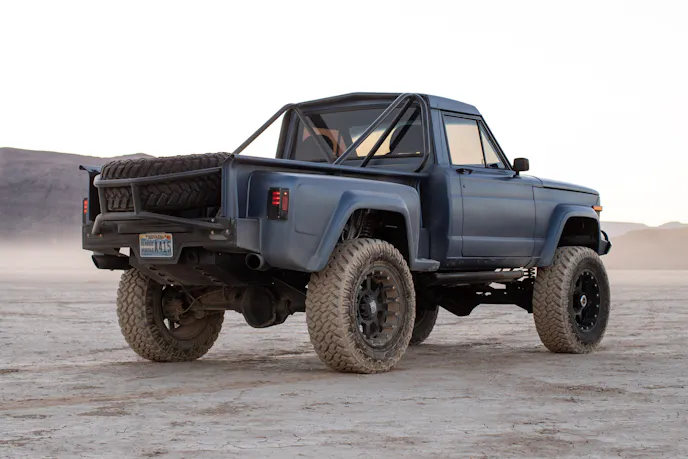
The "Wicked" nature of this build comes from its fabrication. Nefarious Kustoms didn't just bolt parts on; they reimagined the J10's architecture. The rear half of the original frame was removed and replaced with a custom back-half chassis constructed from 1.75-inch DOM tubing. This provides the structural rigidity needed for the four-link suspension and the bed-mounted radiator.
Visually, the truck is a masterclass in restomod styling. The body was treated to an Opal Blue Metallic paint job with a matte clearcoat, giving it a modern, tactical appearance. The front end received a Rhino grille conversion, a throwback to the early 1960s Gladiators that many FSJ enthusiasts consider the pinnacle of Jeep design. To accommodate the wider stance and increased travel, the step sides of the bed were widened by 6 inches, giving the truck a muscular, wide-body look that matches its performance.
Interior: SRT10 Comfort and Viper Gauges
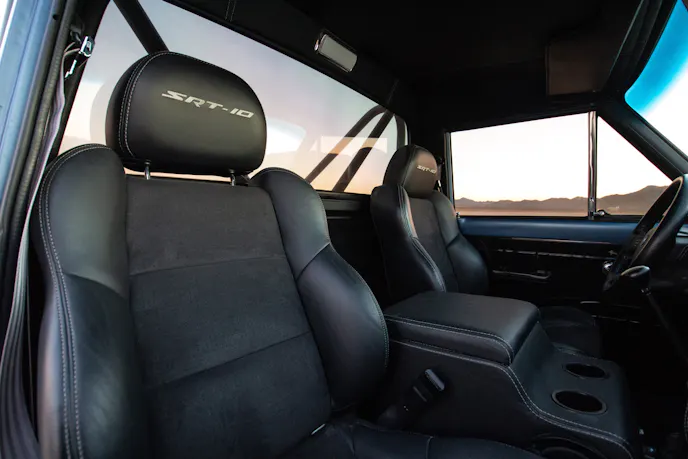
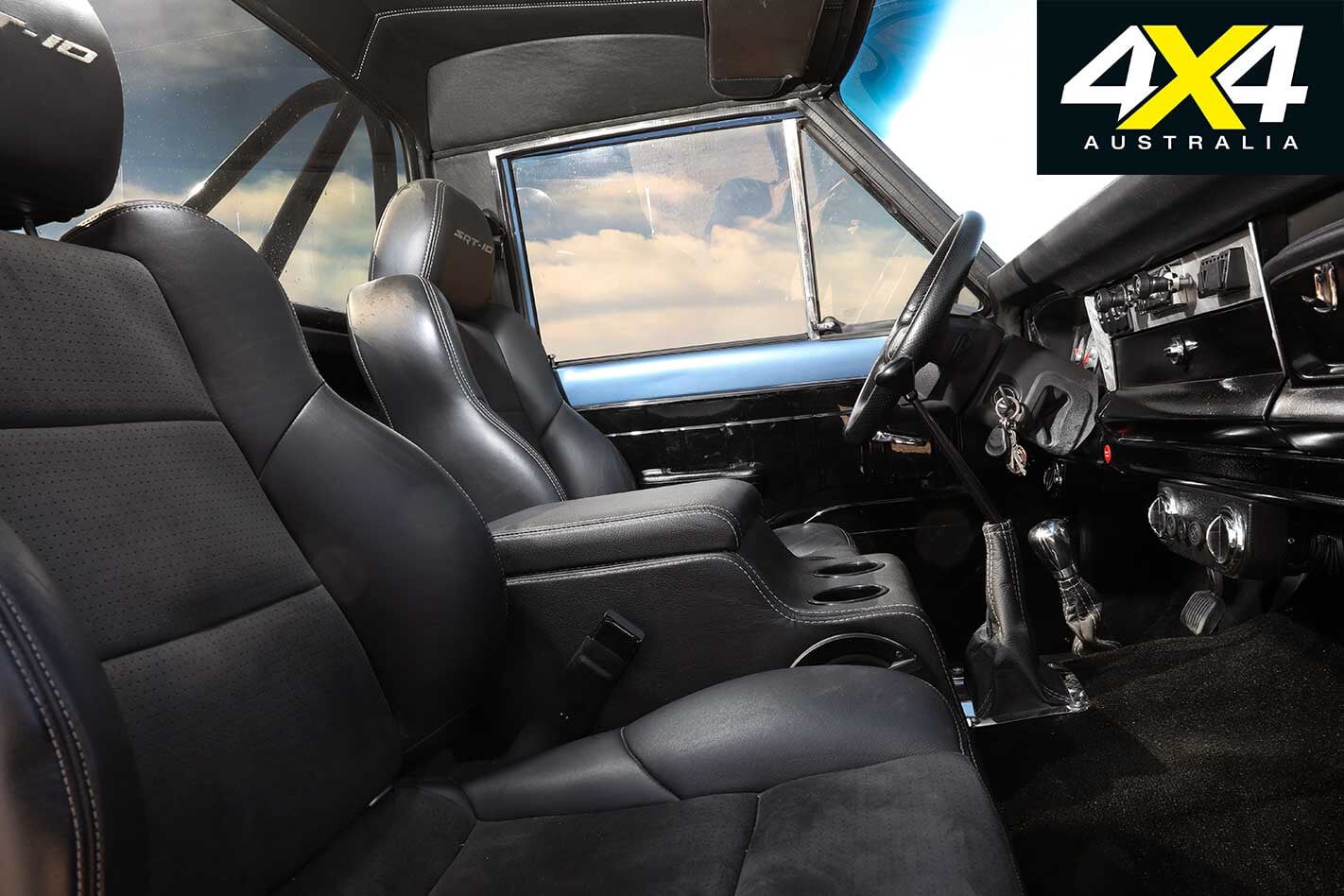
Stepping inside the 'Viperceptor,' the vintage 1984 vibes are replaced by modern performance luxury. Instead of trying to adapt old Jeep gauges to work with the new electronics, the builders performed a full interior transplant from the 2004 Ram SRT10.
The dashboard now houses the functional Viper gauge cluster, providing accurate readouts for the V10's vitals. The steering column and power leather seats were also brought over from the SRT10 donor, offering the side bolstering necessary to keep the driver planted during aggressive cornering. To ensure the truck remains usable in the scorching Las Vegas summers, an Old Air A/C system was integrated into the dash. It is a seamless blend of classic utility and modern comfort, making this restomod truck as pleasant to drive on the highway as it is on the trail.
FAQ
How much horsepower can you get out of a Viper V10?
In factory trim, the 8.3L V10 engine produces 500 horsepower and 525 lb-ft of torque. However, because these engines are essentially "overbuilt" aluminum blocks, aftermarket tuners can easily push them to 600+ horsepower with basic bolt-ons, or well over 1,000 horsepower with forced induction (turbocharging or supercharging).
What cars can fit a Viper engine?
The Viper V10 is a very long engine, making it a popular choice for vehicles with long engine bays like the Dodge Ram, classic muscle cars, and full-size trucks like the Jeep J10. It has also been famously swapped into smaller platforms like the Mazda RX-7 and even some BMWs, though these require extensive firewall and transmission tunnel modifications.
Why are V10s so rare?
V10 engines are expensive to manufacture and difficult to package due to their length. They occupy a middle ground between the common V8 and the high-end V12, but they often lack the inherent balance of a V12. As automotive manufacturers shift toward smaller-displacement turbocharged engines and electrification for better fuel economy, the thirsty and large V10 has largely been phased out of production.
Is a V10 smoother than a V8?
Generally, no. A V8 with a 90-degree bank angle is naturally very well-balanced. A V10 engine, especially one with a 90-degree bank angle like the Viper, has an inherent secondary imbalance that creates a unique vibration and a distinctive "odd-fire" exhaust note. However, for many enthusiasts, this mechanical "shiver" and the unique sound are exactly what make the V10 so desirable.