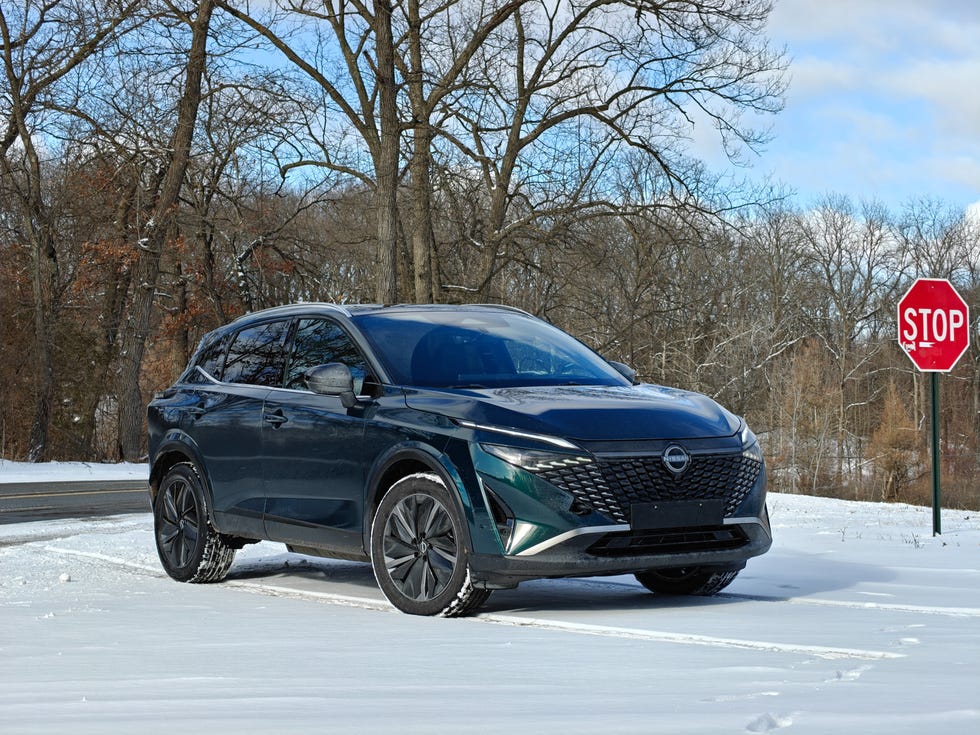
Most hybrids on the market today feel like a compromise—a mechanical tug-of-war between a gasoline engine and an electric motor, often mediated by a complex transmission that never quite knows which side to favor. But standing on the throttle of Nissan’s 3rd-generation e-Power system, that familiar "rubber-band" sensation of a CVT is nowhere to be found. Instead, you get the linear, neck-snapping torque of an EV, despite the fact that there’s a turbocharged three-cylinder humming under the hood. It is, quite literally, a diesel-electric locomotive scaled down for your driveway.
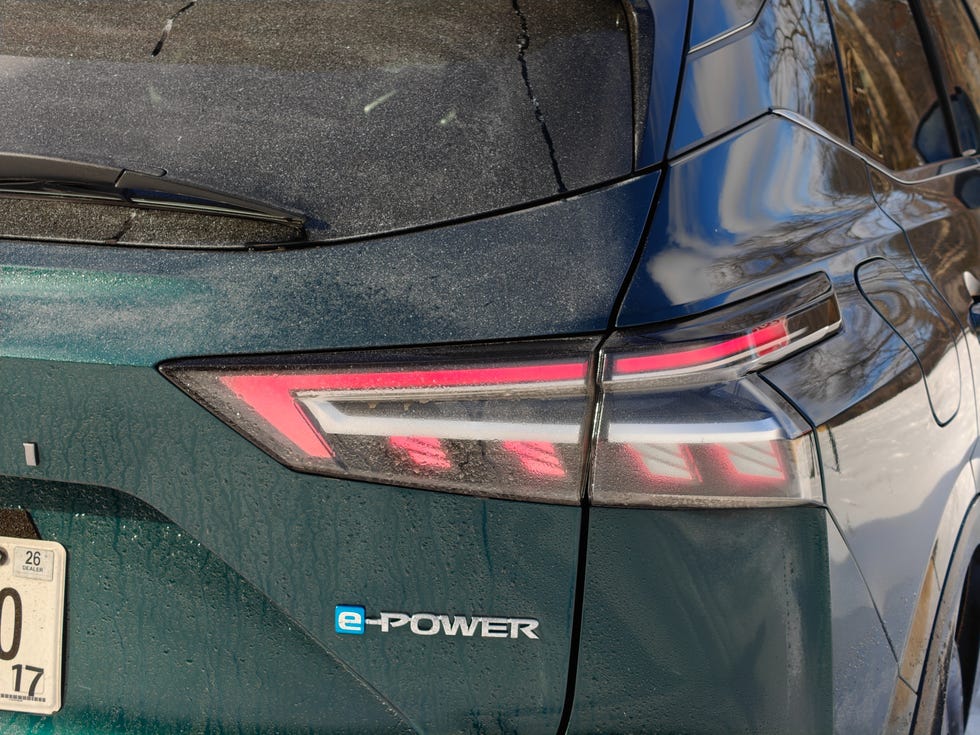
Nissan e-Power is a unique hybrid system where the internal combustion engine acts solely as a generator to supply electricity to an electric motor, which provides 100% of the drive power to the wheels without a traditional gearbox. While the rest of the world has enjoyed this technology for a few years, it is finally slated to make its North American debut in the 2027 Nissan Rogue. For those of us who care about how a car actually moves, this isn't just another hybrid; it’s a fundamental shift in how we think about the relationship between fuel and motion.
The Heart of the System: The 1.5L STARC Turbo Generator
In a conventional hybrid, like the Toyota RAV4, the engine can drive the wheels directly. In Nissan’s e-Power setup, the engine is physically disconnected from the driveline. This allows Nissan’s engineers to optimize the engine for one specific job: spinning at the most efficient RPM to generate electricity.
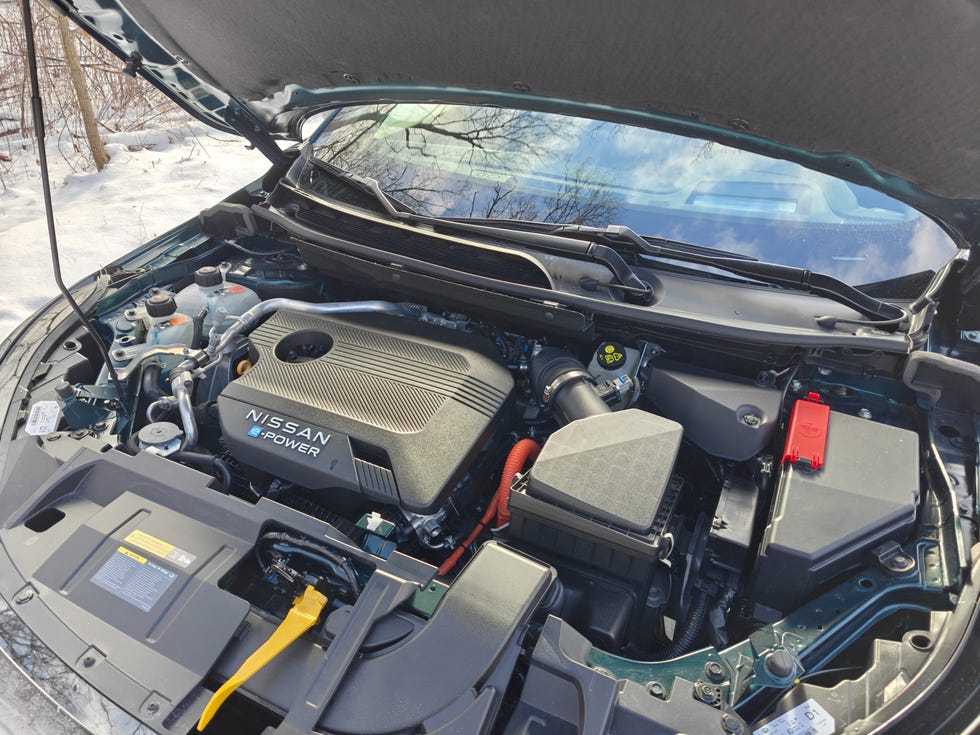
The 3rd-gen system features a 1.5-liter turbocharged inline-three engine. If you're wondering why a "generator" needs a turbocharger, the answer lies in American driving habits. US highways require sustained high-speed cruising, which places a massive load on the battery and motor. The turbo provides the necessary "lung capacity" to keep the electricity flowing without forcing the engine to scream at redline.
To squeeze every bit of energy out of a drop of fuel, Nissan uses what they call STARC technology (Strong Tumble and Radical Combustion). By creating a more violent air-fuel mixture in the cylinder, the engine achieves a 42% thermal efficiency rating. In the world of internal combustion, that is a massive figure—most passenger car engines struggle to break 35%. This high efficiency ensures that even though the engine is running to create power, it’s doing so with minimal waste.
The Engineering Magic: The 5-in-1 Modular Drive Unit
The real breakthrough for the 3rd-generation system is its packaging. Previous iterations of e-Power used separate housings for various components, which added weight and took up valuable engine bay real estate.
The 3rd-generation Nissan e-Power system utilizes a modular 5-in-1 drive unit that integrates the electric motor, inverter, generator, reducer, and increaser to reduce weight and packaging complexity. Nissan's 5-in-1 modular unit integrates these five major components into a single compact assembly, allowing it to fit into the same space as a standard gasoline engine.
By shrinking the inverter by 40% and the motor by 25% compared to the 2nd-gen system, Nissan has managed to pull off a "packaging miracle." This modularity isn't just about weight; it’s about shared architecture. By using a "Lego-block" approach to parts, Nissan can scale this system across different vehicle sizes, from small hatchbacks to the larger Rogue, without reinventing the wheel every time.
Driving Dynamics: An EV Experience Without the Plug
From the driver’s seat, the e-Power system feels remarkably refined. Because the wheels are 100% driven by the electric motor, you get 202 hp and 243 lb-ft of torque delivered instantly. There is no waiting for a transmission to downshift, no hesitation as a clutch engages, and no "searching" for the right gear.
One of the biggest complaints with "series hybrids" in the past was the disconnect between your right foot and your ears—the engine would often rev high while the car was moving slowly. Nissan has addressed this with "Linear Tune" software. The system monitors vehicle speed and throttle input, adjusting the engine's RPM to match what your brain expects to hear. If you accelerate hard, the engine revs up in sync; if you’re coasting, it shuts off or idles quietly.
For the US-market Rogue, Nissan is expected to use an e-4ORCE AWD system. This adds a second electric motor to the rear axle. Because there is no mechanical driveshaft connecting the front and rear, the power distribution can be adjusted 10,000 times per second. This provides a level of handling precision that traditional mechanical AWD systems simply can't match.
3rd-Gen e-Power Technical Specifications
| Feature | Specification |
|---|---|
| Engine Type | 1.5L Turbocharged Inline-3 (Generator Only) |
| Drive Power | 100% Electric Motor |
| Thermal Efficiency | 42% (with STARC Technology) |
| Drive Unit | 5-in-1 Modular (Motor, Inverter, Generator, Reducer, Increaser) |
| Est. Power Output | 202 hp / 243 lb-ft Torque |
| Transmission | None (Direct Drive via Electric Motor) |
| AWD System | e-4ORCE Dual-Motor |
Efficiency and the US Market Reality
When the 2027 Rogue e-Power hits the States, it will enter a cage match with the Toyota RAV4 Hybrid and the Honda CR-V Hybrid. Both of those competitors use systems where the engine can physically assist in driving the wheels at high speeds.
"The e-Power's advantage isn't just about the numbers on a spec sheet; it's about the smoothness of the delivery. In stop-and-go city traffic, the 'No-Gearbox' setup is inherently more comfortable than any planetary gear or dual-clutch system." — Logan Reeves
While official EPA ratings are still a year or more away, real-world testing of the European Qashqai (the Rogue's smaller sibling) suggests we can expect roughly 40 mpg highway and 44 mpg city. While that may be slightly lower than the RAV4's highway figures, the e-Power wins on "EV feel."
Nissan also includes its e-Pedal Step technology. By lifting off the accelerator, the car uses regenerative braking to slow down significantly, allowing for "one-pedal-ish" driving. It won't bring the car to a complete stop like a Leaf or an Ariya, but it makes navigating heavy traffic significantly less taxing.
Conclusion: Is the No-Gearbox Hybrid the Future?
Nissan’s 3rd-gen e-Power is a bold engineering bet. By ditching the gearbox entirely, they have simplified the drivetrain while simultaneously making the driving experience more complex and rewarding. It offers the silent, punchy responsiveness of an EV for those who aren't quite ready to deal with charging stations and range anxiety.
For the enthusiast, the "No-Gearbox" setup is a win for smoothness and technical elegance. For the everyday driver, it’s a way to get 40+ mpg without having to endure the groans and drones of a traditional hybrid. When the 2027 Rogue arrives, it won't just be another SUV; it will be a 42%-thermal-efficiency power plant on wheels.
FAQ
Does the Nissan e-Power ever need to be plugged in? No. Unlike a Plug-in Hybrid (PHEV), the e-Power system is a "Series Hybrid." All the electricity needed to power the drive motor is generated on-board by the 1.5L gasoline engine or recovered through regenerative braking. You simply fill it with gas like a normal car.
Why is a "no-gearbox" system better than a CVT? Traditional CVTs (Continuously Variable Transmissions) often feel disconnected from the engine's speed, creating a "sliding" sensation. Because e-Power uses an electric motor for 100% of the drive, torque is instant and the power delivery is perfectly linear, similar to a high-end EV.
Is the e-Power system reliable? By removing the complex mechanical transmission (gears, clutches, belts), Nissan has actually reduced the number of moving parts that can fail under high friction. The 3rd-gen 5-in-1 unit is designed for modularity and durability, though long-term US highway reliability will be proven once it launches in 2027.