Quick Facts
- Target Engine: 6.0L LQ9 LS V8 with roughly 300 hp for reliable trail torque
- Transmission: NV3550 5-speed manual swap from a TJ Wrangler
- Drivetrain: Twin-stick Dana 300 transfer case and Dana 44 wide-track axles
- Suspension: 3-inch custom lift using modified leaf springs for 34-inch all-terrain tires
- Unique Specs: 120-inch wheelbase and 22-slot Razor Grille for the vintage look
- Moab Readiness: ARB Air Lockers and 4.09:1 gearing for technical rock crawling
Build a trail-ready legend with our guide to preparing a jeep j10 for the easter jeep safari featuring an LQ9 LS swap and heavy-duty drivetrain upgrades. Preparing a jeep j10 for off-road trails like Moab requires upgrading the drivetrain with an ls engine swap jeep j10 guide (like the 6.0L LQ9), a twin-stick transfer case, and dana 44 axle upgrades to handle technical rock crawling while maintaining the Full-size Jeep (FSJ) aesthetic.
The Heart of the Build: 6.0L LQ9 LS Swap
When we talk about the Full-size Jeep (FSJ) community, there is no bigger debate than what belongs under the hood. While the original AMC powerplants have their charm, they often struggle with the thin air and steep inclines of Utah. For our Moab prep, we opted for the 6.0L LQ9 V8. While many budget builders look at the 5.3-liter LM7, which produces between 270 and 302 horsepower in stock form, the 6.0L LQ9 offers that extra grunt needed to move a heavy truck over obstacles.
Sourcing a donor engine is only the first step. Before we dropped the block into the engine bay, we ran through a mandatory "while it is on the stand" checklist:
- Replace the rear main seal and water pump to prevent trail-side leaks.
- Swap the stock oil pan for a high-clearance version to avoid rock strikes.
- Install a standalone wiring harness to simplify the electronic fuel injection integration.
- Upgrade to a high-flow 1966 Impala radiator, which surprisingly fits the J10 core support with minimal bracket fabrication.
Fuel delivery is another hurdle. We decided to ditch the vintage tank for a 1994 Ford F-150 fuel tank conversion. It fits between the rear frame rails, providing better weight distribution and a modern fuel pump assembly that handles the pressure requirements of the LQ9 V8 conversion perfectly. This setup ensures that whether we are climbing a 30-degree ledge or cruising the highway, the engine never starves for gas.
Trail-Hardened Drivetrain & Axles
Power is useless if you cannot get it to the dirt. To keep the driving experience engaging, we mated the LS engine to a TJ Wrangler NV3550 five-speed manual transmission using a custom adapter plate. This gearbox gives us a solid overdrive for the long drive to Moab while remaining robust enough for low-speed technical work.
Behind the transmission sits the legendary Dana 300 transfer case. We converted it to a twin-stick configuration, allowing us to shift the front and rear axles independently. This is a game-changer for tight turns on the trail where a "front dig" can help pivot the 120-inch wheelbase around a sharp rock. We also swapped in a 4:1 low-range gear set to provide the precision needed for slow-motion rock crawling.
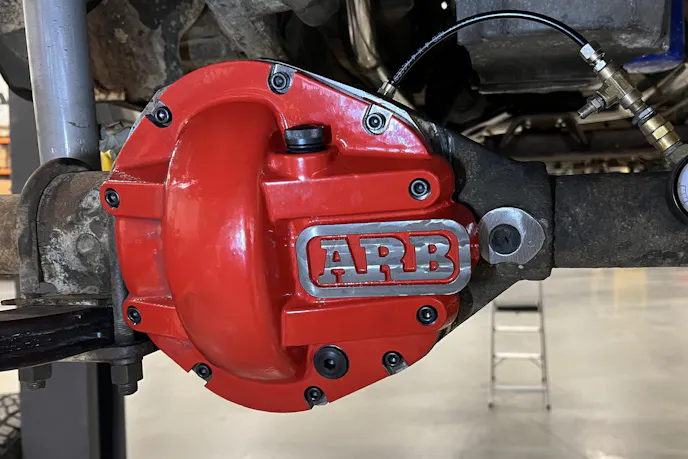
For the corners, we moved away from the stock narrow axles. Our build utilizes dana 44 wide-track axles pulled from a Cherokee Chief. These give the jeep j10 a wider stance for better stability on off-camber sections. We stuffed these housings with 4.09:1 gears and ARB Air Lockers. This gearing is the "sweet spot" for our tire choice, balancing trail torque with a comfortable 2,200 RPM at highway speeds.
System Checklist: Mechanical Specs
| Component | Choice | Benefit |
|---|---|---|
| Engine | 6.0L LQ9 LS V8 | High torque, modern reliability |
| Transmission | NV3550 5-Speed | Manual control with overdrive |
| Transfer Case | Dana 300 (Twin-stick) | Front-only drive options for tight turns |
| Front Axle | Dana 44 (Wide-track) | Increased stability, ARB locker |
| Rear Axle | Dana 44 (Wide-track) | Matching track width, 4.09:1 gears |
| Cooling | 1966 Impala Radiator | Fits FSJ core support, high capacity |
Suspension Tuning for Moab Trails
Moab is a unique beast. The annual Easter Jeep Safari, which started as a tiny gathering in 1967, now sees an average of 2,000 participating vehicles annually. For the 2025 event, the trails were more crowded than ever, with over 1,500 registrations and thousands of enthusiasts testing their builds on over 40 distinct trails. With that many eyes on our truck, the stance had to be perfect.
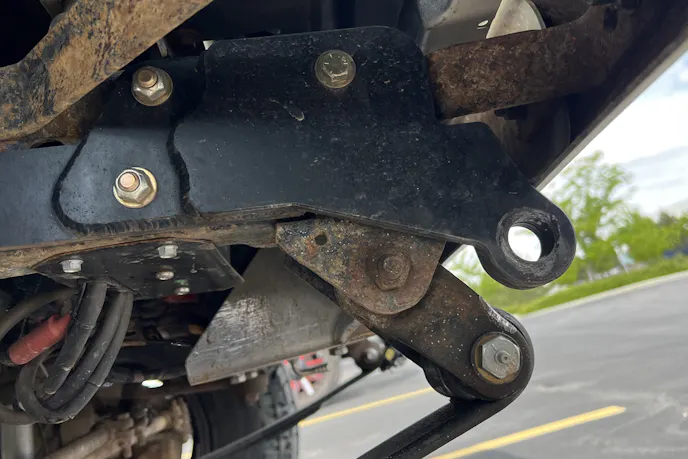
Managing the jeep j10 specs for a 120-inch wheelbase requires a lift that provides ground clearance without making the truck top-heavy. We designed a 3-inch custom lift using a mix of original leaf springs and add-a-leafs to achieve the right spring rate. This allows the truck to soak up the "bump-at-the-bottom" transitions found in Moab washes while maintaining enough tension to carry a load of gear in the bed.
For the footprint, we landed on an off-road tire size for jeep j10 that balances form and function: 34-inch all-terrain tires on 17-inch wheels. This combination offers plenty of sidewall flex when aired down to 15 PSI on the slickrock. We also spent considerable time on leaf spring tuning to ensure the rear end did not "chatter" during steep climbs—a common issue with vintage spring-under-axle designs.
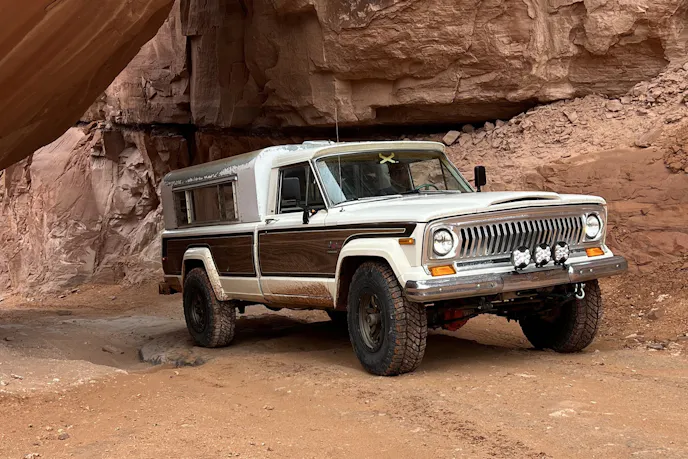
Preparing a jeep j10 for easter jeep safari also means thinking about self-sufficiency. Since the truck's bed is expansive, we installed an onboard air system and a custom rack for recovery boards. We paired this with a 1975 Caravan Camper shell, giving us a "vintage survivalist" look that turns heads while providing a dry place to sleep between trail days.
Aesthetic Preservation: Honcho and Gladiator Roots
While the guts of this truck are modern GM and heavy-duty Jeep parts, the exterior remains a tribute to the legacy of the Jeep J10 Series Gladiator. The J-series trucks saw several visual evolutions, but the most sought-after is the 1974-1978 era. These models featured the iconic 22-slot Razor Grille, which we retrofitted onto our build to replace the later, more common square-headlight Muscle Grille.
If you are looking at a jeep j10 honcho, you are looking at the pinnacle of 1970s truck style. The Honcho package was famous for its bold multi-colored stripes and factory roll bars. While our build is more of a restomod restoration, we kept the spirit of the Honcho alive by maintaining the classic body lines and period-correct emblems.

Preserving the vintage identity while adding high-tech functionality is the ultimate goal. We added subtle rock sliders tucked under the rocker panels and a hidden winch behind the front bumper. These modifications ensure we can tackle Level 6 and 7 trails like Hell’s Revenge or Poison Spider without destroying the classic sheet metal.
FAQ
What engine does a J10 Jeep have?
Originally, the J10 came with a variety of engines depending on the year, including the 258 cubic-inch inline-six and the AMC 360 or 401 V8. However, many modern builders opt for an ls engine swap jeep j10 guide to replace these aging powerplants with modern fuel-injected GM V8s like the 5.3L or 6.0L versions for better reliability on the trail.
What is a Jeep J10 considered?
The J10 is considered a Full-size Jeep (FSJ) and is part of the Gladiator series of pickups produced by Jeep from the 1960s through the 1980s. It is a half-ton rated truck characterized by its body-on-frame construction and rugged leaf-spring suspension, making it a favorite for restoration and off-road builds.
Are Jeep J10 reliable?
In their stock, vintage form, the reliability of a J10 depends heavily on the condition of its aging vacuum lines and AMC-sourced electrical systems. When modernized with an LS swap and upgraded axles, they become incredibly robust machines that can handle daily driving and intense trail use with minimal mechanical drama.
How much is a Jeep J10 worth?
The value of a J10 varies wildly based on condition and trim. A base model project might sell for $5,000, while a fully restored or restomodded jeep j10 honcho in excellent condition can command $30,000 to $50,000 or more, especially if it features high-quality upgrades like fuel injection and modern drivetrain components.
Conclusion & Trail Readiness
Taking a classic truck like the J10 to Moab is more than a test of mechanical skill; it is a pilgrimage. By focusing on a reliable LS V8 conversion, strengthening the drivetrain with Dana 44 axles, and refining the suspension for the unique terrain of the Utah desert, we have turned a vintage workhorse into a modern trail weapon.
Before you head to the Red Rocks, perform a final nut-and-bolt check on your suspension and ensure your cooling system is pressurized and leak-free. The community of Full-size Jeep (FSJ) owners is a knowledgeable and welcoming group, so do not be afraid to reach out for parts sourcing or technical advice. We will see you on the slickrock!