The arrival of a new flagship Ferrari is never merely a product launch; it is a seismic shift in the automotive landscape. When Maranello decides to resurrect the "Testarossa" moniker—a name synonymous with the excess of the 1980s and the literal "redheaded" cylinder heads of the 1950s—the stakes are stratospheric. The Ferrari 849 Testarossa is not just a replacement for the SF90 Stradale; it is a declaration of dominance in the hybrid era. By blending brutal internal combustion with cutting-edge electrification, Ferrari has created a "four-figure hellion" that bridges the gap between a traditional supercar and the experimental realm of the hypercar.
The Ferrari 849 Testarossa is the official successor to the SF90 Stradale, featuring a total power output of 1036 hp from a heavily revised 4.0-liter twin-turbo V8 and three electric motors. Starting at a base price of $565,685, it is positioned to undercut key rivals like the Lamborghini Revuelto while delivering performance statistics that were unthinkable just a decade ago.
Performance and Powertrain: Breaking the 1000 HP Barrier
At the heart of the 849 Testarossa lies an evolution of the F154 engine family, but to call it a simple "update" would be an injustice. This 4.0-liter twin-turbo V8 now produces a staggering 819 hp and 621 lb-ft of torque on its own. This represents a significant increase of 50 hp and 31 lb-ft over the outgoing SF90, achieved through the use of Inconel exhaust manifolds and a higher 350-bar fuel injection system.
However, the "Testarossa" magic happens when the V8 marries its electric counterparts. The triple-motor setup—consisting of two independent motors on the front axle and a rear axial-flux unit sandwiched between the engine and the new 8-speed dual-clutch transmission—adds another 217 hp to the mix. The result? A combined 1036 hp that propels the car from 0 to 62 mph in less than 2.3 seconds. More impressively, the Ferrari 849 Testarossa can accelerate from 0 to 124 mph in just 6.35 seconds, a figure that puts it squarely in the crosshairs of the limited-run SF90 XX.
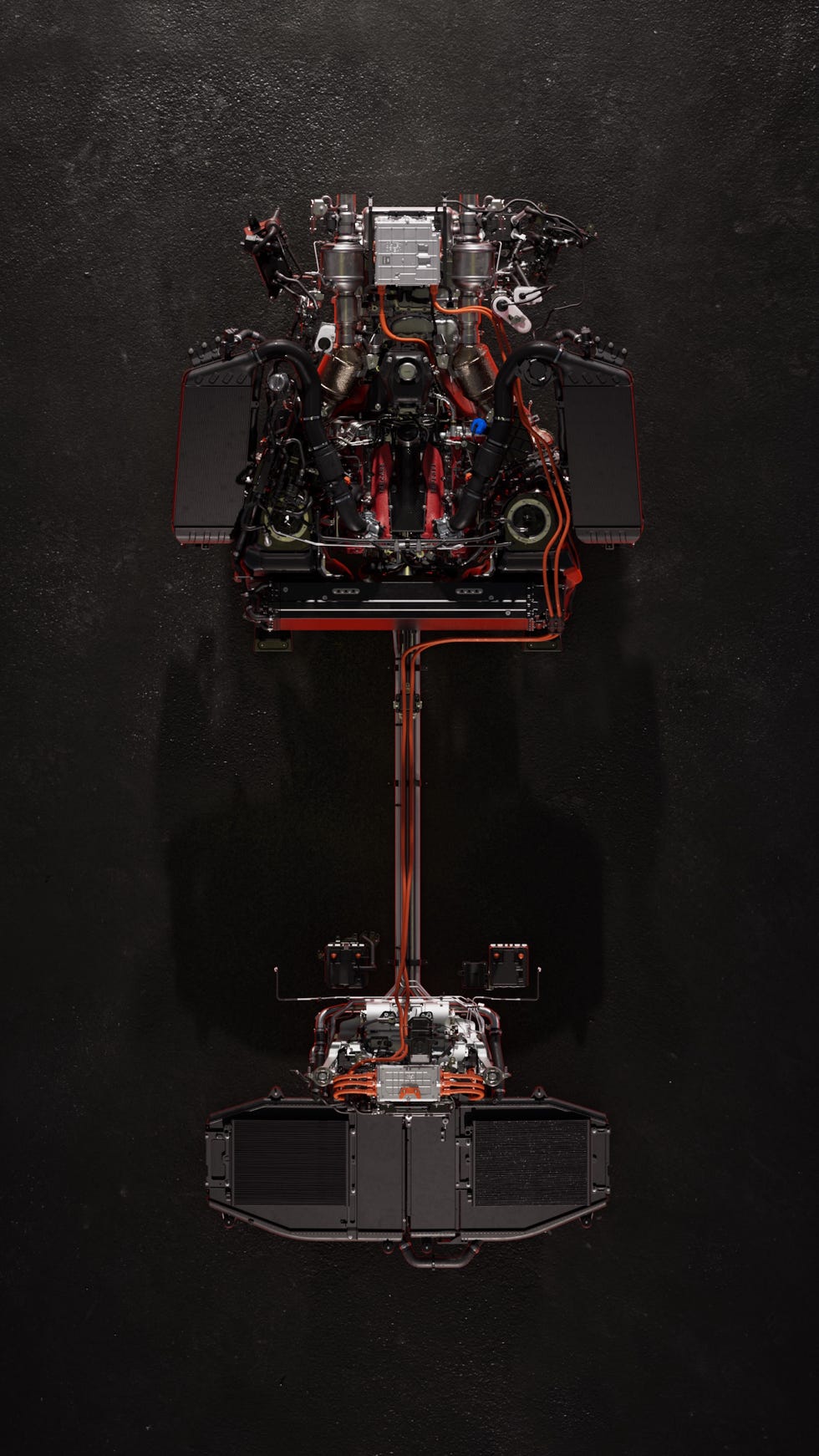
The powertrain is managed by a sophisticated 7.9 kWh battery pack. While it allows for a silent, front-wheel-drive "eDrive" mode for up to 25km of urban crawling, its primary purpose is "torque filling"—eliminating any hint of turbo lag and providing instantaneous throttle response that feels almost telepathic.
Engineering the 'Digital Twin': FIVE Software
Ferrari has long understood that power is nothing without control. To manage the 849's massive output, Maranello introduced the Ferrari Integrated Vehicle Estimator (FIVE) software. Think of this as a "digital twin" of the car’s physics running in real-time within the ECU.
Expert Insight: The FIVE system calculates the car's grip and yaw angle with less than 1 degree of error. This allows the e4WD system to distribute torque to the front wheels with surgical precision, making a 1000-plus horsepower car feel approachable even for non-professional drivers.
The integration of the ABS Evo system, first seen on the 296 GTB, has been further refined here. It works in tandem with the 6-way Chassis Dynamic Sensor (6w-CDS) to optimize braking distances and turn-in stability. The result is a car that doesn't just fight physics but seems to rewrite the rules of traction and deceleration.
Design and Aerodynamics: From 'Zorro' to Assetto Fiorano
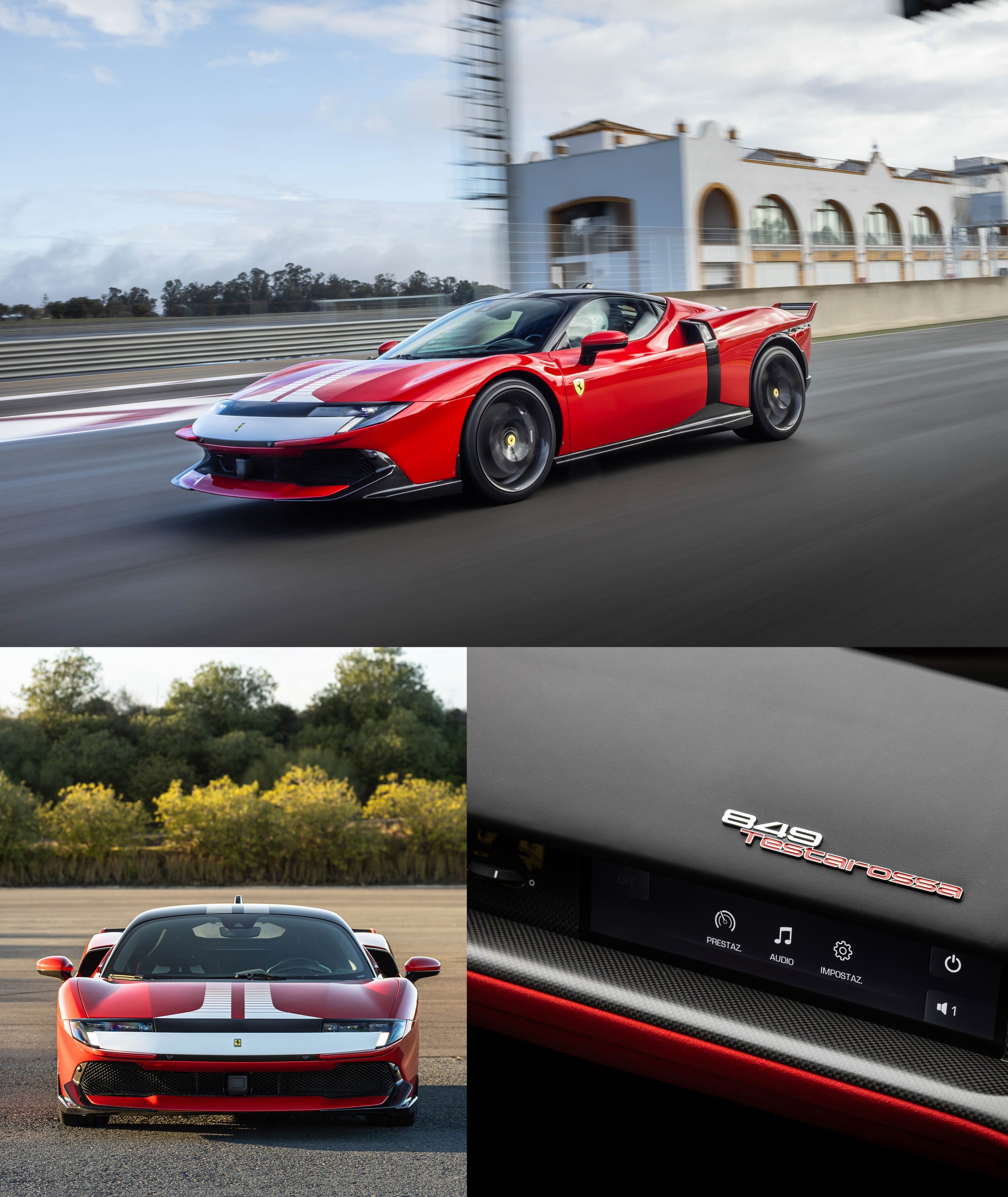
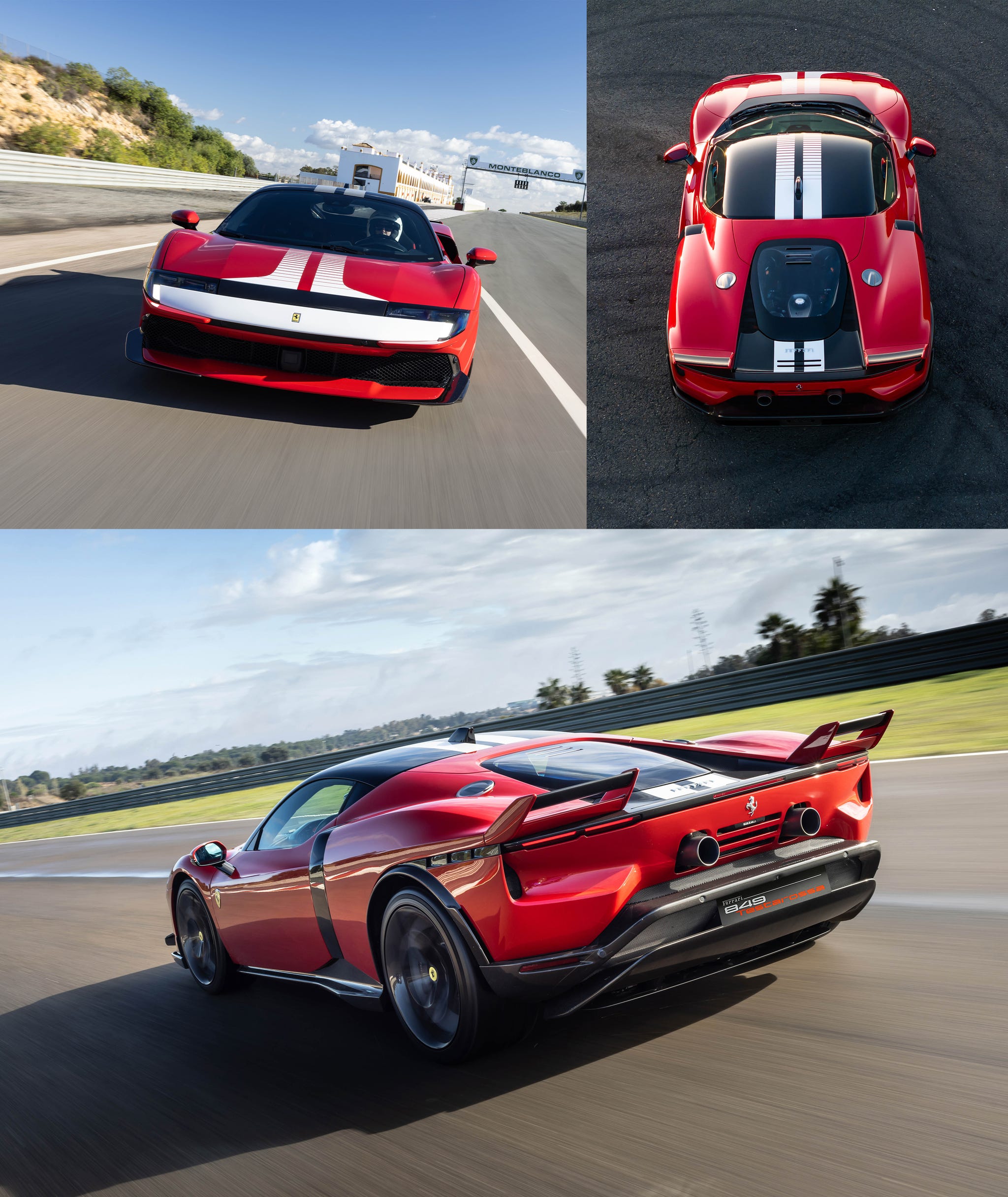
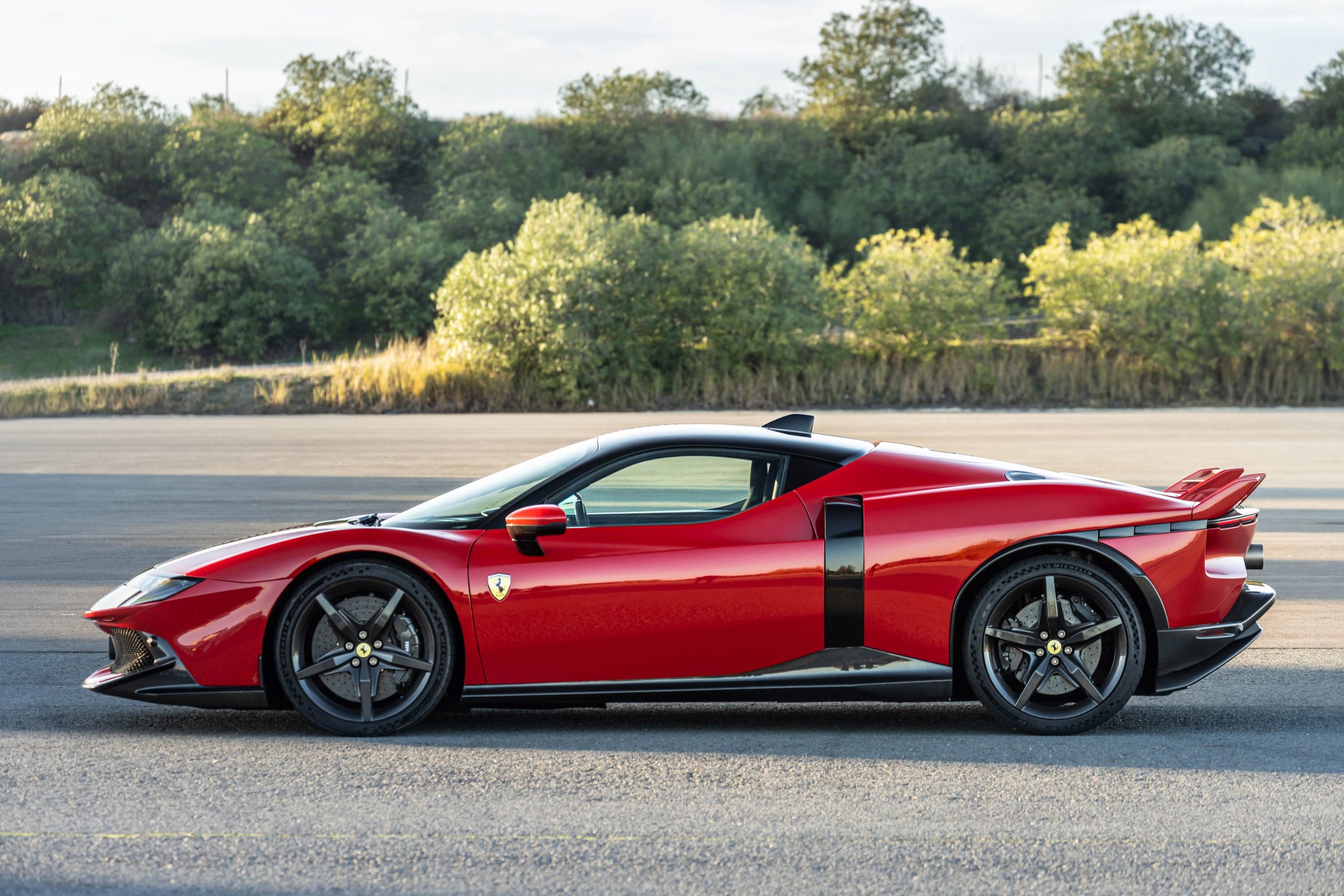
Visually, the 849 Testarossa moves away from the curvaceous lines of the F8 and toward a more technical, aggressive aesthetic. The most striking feature is the "Mask of Zorro" front graphic—a blacked-out aerodynamic element that hides the cooling intakes and active flaps.
The rear of the car pays homage to the 512 S with a "twin tail" design, where the bodywork seems to float over the massive rear diffuser. Aerodynamics are not just for show; the 849 utilizes an active center element in the front underbody and a shut-off Gurney flap at the rear to balance drag and downforce.
For those who intend to spend their weekends at the circuit, Ferrari offers the Assetto Fiorano track package. This lightweight specification includes:
- GT-Derived Dampers: Fixed-rate Multi-matic shock absorbers optimized for track use.
- Weight Reduction: Extensive use of titanium and carbon fiber, shedding roughly 66 lbs.
- High-Downforce Rear Wing: A more aggressive carbon fiber spoiler.
Equipped with the Assetto Fiorano track package, the Ferrari 849 Testarossa generates a massive 915 pounds of aerodynamic downforce at a speed of 155 mph, ensuring the car remains glued to the tarmac through high-speed sweepers.
Interior and Ergonomics: The Return of Tactile Control
In a move that mirrors Apple’s decision to bring back physical ports and keys to the MacBook, Ferrari has listened to customer feedback regarding the SF90’s much-maligned haptic controls. The 849 Testarossa marks a refreshing return to tactile ergonomics.
While the 16-inch curved digital instrument cluster remains, the steering wheel now features physical switches for the most critical functions. The haptic "touchpads" that often frustrated drivers in the SF90 have been replaced by solid, clicky buttons that provide immediate feedback.
The center console features a floating design with a gear-selector gate that mimics the iconic "click-clack" manual gates of Ferraris past, like the original Testarossa. It is a masterful blend of nostalgia and futurism. Furthermore, the infotainment system has been overhauled with a dedicated chip for wireless Apple CarPlay and Android Auto, significantly reducing the lag that plagued earlier iterations.

Driving Impressions: Road Refinement vs. Track Savagery
Sliding into the carbon-fiber bucket seats, the first thing you notice is the visibility. Ferrari has slimmed down the A-pillars, giving you a panoramic view of the road ahead. In "Hybrid" mode, the car starts in silence. You can pull away from your driveway without waking the neighbors, gliding on electric power with a surprisingly supple ride quality thanks to the adaptive magnetorheological dampers.
However, rotate the Manettino dial to "Performance" or "Qualifying," and the V8 awakens with a guttural bark that resonates through the Inconel exhaust. As you floor the accelerator, the sensation is violent yet controlled. The electric motors provide a "shove" that bridges the gap while the turbos spool, resulting in a linear, never-ending surge of speed.
On a twisty B-road, the 849 feels smaller than it is. The steering is lightning-fast, and the "Bumpy Road" mode allows the suspension to soak up mid-corner imperfections without upsetting the chassis. On the track, the FIVE software becomes your silent co-pilot. You can trail-brake deep into a corner, and the system will subtly nibble at the front brakes to help the car rotate. It makes you feel like a hero, even when you're managing 1036 hp on the limit.
Pricing and Market Rivalry
Ferrari has positioned the 849 Testarossa with a strategic eye on the competition. Starting at $565,685 for the Coupe, it sits in a sweet spot of the "super-hybrid" market. While a Spider version is expected to follow with a price tag north of $615,000, the base Coupe offers a performance-per-dollar ratio that is hard to ignore.
| Feature | Ferrari 849 Testarossa | Lamborghini Revuelto | Aston Martin Valhalla |
|---|---|---|---|
| Engine | 4.0L V8 Twin-Turbo + 3 Motors | 6.5L V12 NA + 3 Motors | 4.0L V8 Twin-Turbo + 2 Motors |
| Total HP | 1036 HP | 1001 HP | 998 HP |
| 0-62 MPH | < 2.3 Seconds | 2.5 Seconds | 2.5 Seconds |
| Base Price | $565,685 | ~$608,000 | ~$800,000 |
The Ferrari 849 Testarossa starts at a base price of $565,685, which is positioned lower than competitors like the Lamborghini Revuelto and Aston Martin Valhalla. This pricing strategy, combined with the sheer power output, makes the 849 a formidable threat to both established European rivals and high-performance American outliers like the Chevrolet Corvette ZR1.
Conclusion: Does it Earn the Name?
The 1984 Testarossa was a poster child for a generation—a wide, flat, flamboyant symbol of Italian flair. The 849 Testarossa is different. It is a precision instrument, a "digital twin" brought to life through software and electricity. It replaces the SF90 Stradale not just by adding power, but by adding soul and usability back into the cockpit.
By returning to physical buttons, refining the hybrid transition, and pushing the boundaries of aerodynamic downforce, Ferrari has ensured that the "Testarossa" name continues to represent the pinnacle of what is possible. It is visceral, it is savage, yet it is refined enough to be driven every day. The 849 is more than a successor; it is the new benchmark.
FAQ
How does the 849 Testarossa compare to the SF90 XX? While the SF90 XX was a limited-edition, track-focused special, the 849 Testarossa actually surpasses it in total horsepower (1036 hp vs 1016 hp). The 849 also features more advanced FIVE software, though the XX remains slightly lighter due to its extreme stripping of interior comforts.
Is the Ferrari 849 Testarossa a plug-in hybrid? Yes, the 849 Testarossa is a PHEV (Plug-in Hybrid Electric Vehicle). It features a 7.9 kWh battery that can be charged via an external outlet or through the V8 engine and regenerative braking while driving.
What is the 'e4WD' system in the 849? The e4WD system uses two independent electric motors on the front axle to provide active torque vectoring. This allows the car to pull itself out of corners and provides all-wheel-drive grip without the weight and complexity of a traditional mechanical driveshaft connecting the front and rear.
Ready to Experience Maranello’s Latest?
Whether you are a collector looking for the next centerpiece or an enthusiast following the evolution of the hybrid supercar, the 849 Testarossa is a milestone. Stay tuned for our deep-dive video review where we take the 849 to the streets of Maranello.