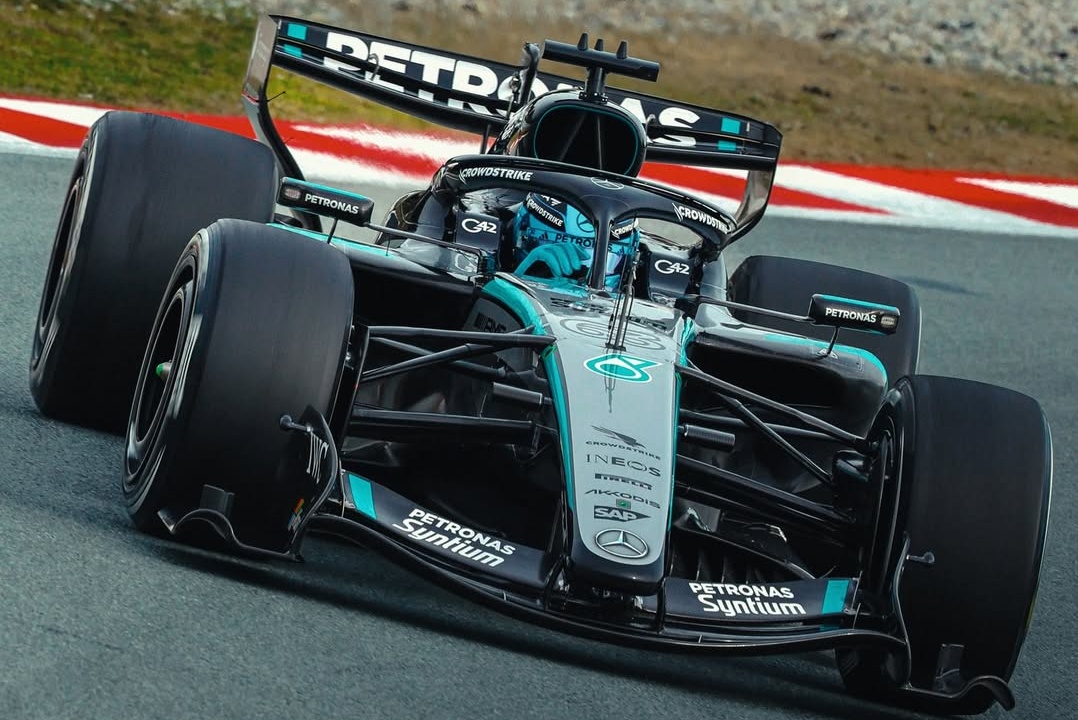
The silence emanating from the Mercedes-AMG Petronas headquarters in Brackley and the High Performance Powertrains (HPP) facility in Brixworth is not the silence of defeat; it is the focused, terrifying quiet of a team that knows it has found something. To the seasoned Formula 1 observer, the atmosphere feels eerily similar to the winter of 2013. Back then, Mercedes was preparing to unleash a hybrid power unit so dominant it would reset the sport for nearly a decade. Now, as the 2026 regulatory reset looms, the Mercedes W17 has emerged from its first real-world evaluations in Barcelona not just as a contender, but as the clear pacesetter.
Why is Mercedes considered the heavy favorite for the 2026 F1 season? The answer lies in a combination of unprecedented early investment in the "50/50" power unit split and the W17 chassis’s clinical performance during private testing. While rivals like Red Bull-Ford grapple with the steep learning curve of becoming independent manufacturers, Mercedes has leveraged its historical hybrid era pedigree to create a package that mirrors their 2014 transition. The early data from Barcelona suggests that the Silver Arrows have not only caught up to the frontrunners but may have already moved the goalposts.
The Power Unit: A 50/50 Split of Modern Engineering
The heart of the 2026 revolution is a fundamental shift in how a Formula 1 car generates speed. The complex and expensive MGU-H (Motor Generator Unit - Heat) has been consigned to the history books, replaced by a massive expansion of the MGU-K (Kinetic). In the new era, the power delivery is split almost equally between the 1.6-liter V6 internal combustion engine (ICE) and the electrical system, with the MGU-K now producing 350kW—triple its current output.
Mercedes HPP has approached this as an "ecosystem" challenge rather than a simple engine build. By focusing on extreme thermal efficiency and advanced manufacturing tolerances, they are seeking to maximize the reduced fuel flow allowed under the new rules. The shift to 100% sustainable fuels has also triggered a "chemistry war," where Mercedes’ long-standing partnership with PETRONAS is yielding laboratory-grade precision in combustion cycles. This allows the W17 to maintain high ICE performance even as the battery is being drained during high-load phases.
Power Unit Delivery Comparison
| Feature | 2024 Era (Approx.) | 2026 Regulations |
|---|---|---|
| ICE Power Output | ~750 hp | ~540 hp (400kW) |
| Electric Power (MGU-K) | 160 hp (120kW) | 470 hp (350kW) |
| MGU-H Integration | Highly Complex | Removed |
| Fuel Composition | 10% Renewable | 100% Sustainable |
| Energy Recovery | Limited K + Extensive H | Massive K-harvesting only |
"The challenge isn't just making the power; it's the harvest. In 2026, the car that can re-fill its battery the fastest while maintaining top speed will win the race. Mercedes seems to have found a way to make the MGU-K work as a seamless extension of the driver's right foot." — Technical Insider Analysis

The W17 Chassis: Banishing the 'Diva' Forever
Since the ground-effect era began in 2022, Mercedes has been haunted by the "diva" characteristics of its cars—unpredictable porpoising, narrow operating windows, and a disconnect between the simulator and the track. However, the early testing of the W17 indicates that Mercedes has finally solved its porpoising issues for 2026. For the first time since 2021, the team’s aero correlation represents a perfect match: the track performance at Barcelona exactly mirrored the data produced in the Brackley wind tunnel.
The W17 is a physically smaller, more nimble machine. The 2026 regulations mandate a 200mm shorter wheelbase and a 100mm reduction in width, alongside a target weight reduction of 30kg. Mercedes has utilized advanced carbon-fiber layups to hit these weight targets early, allowing them to focus on aero-elasticity rather than "dieting" the car in the final months.
Evolution of Chassis Dimensions
| Dimension | 2021 (Peak Downforce) | 2026 (W17 Specs) |
|---|---|---|
| Wheelbase | 3760 mm | 3400 mm |
| Width | 2000 mm | 1900 mm |
| Max Weight | 752 kg | 722 kg |
| Aero Philosophy | High Downforce Ground Effect | Active Aero / Drag Reduction |
Active Aerodynamics: Mastering X-Mode and Z-Mode
The W17’s secret weapon isn't just raw power; it’s how the car "breathes" through the air. The 2026 rules introduce active aerodynamics, moving away from a simple rear-wing DRS to a dual-element system involving both the front and rear wings. This creates two distinct configurations: Z-Mode for maximum downforce in corners and X-Mode for minimum drag on straights.
Mercedes’ advantage here lies in the synchronization software. If the front and rear wings do not transition simultaneously, the car’s balance can shift violently, leading to instability at 200+ mph. During the three-day Barcelona test, Mercedes maintained remarkably competitive lap times throughout their entire program, only being marginally surpassed by Ferrari and McLaren on the final day—after the team had already concluded their primary data-gathering runs. This consistency suggests the W17 is incredibly stable during these aero transitions, a feat several other teams are still struggling to replicate in simulation.
Strategic Dominance: The Cost Cap Gamble
Mercedes’ emergence as the 2026 leader is the result of a calculated, multi-year gamble. Toto Wolff and the technical leadership effectively accepted "learning years" in 2024 and 2025 to divert maximum R&D resources toward the 2026 project within the constraints of the cost cap. While teams like Red Bull were focused on maintaining their current dominance, Mercedes was building a 2026-first infrastructure.
This strategic pivot has allowed Mercedes to lock in their core designs earlier than their rivals. In the world of the cost cap, an early design lock is a massive financial advantage; it prevents the need for expensive, reactive redesigns mid-season. Furthermore, Mercedes benefits from its customer team network (McLaren, Williams, and Alpine from 2026). The data flow from these multiple sources will accelerate the Mercedes learning curve at a rate that "solo" projects like Audi or Red Bull-Ford may find impossible to match.
The Driver Factor: George Russell’s New Era
What makes the 2026 F1 regulations different for the drivers? It’s no longer just about hitting apexes; it’s about becoming a "systems manager." Drivers will now have manual boost buttons and complex energy management protocols to follow every single lap. The cognitive load is significantly higher, requiring rapid adaptation to the car’s shifting aero balance and energy states.
George Russell’s 2026 championship outlook has shifted from "hopeful" to "highly probable" following the W17's Barcelona consistency. Russell has been deeply embedded in the W17’s development, logging more simulator hours than almost any other driver on the grid. His feedback indicates a car that is predictable and communicative—a stark contrast to the ground-effect machines he has wrestled with since joining the main team.
"The 2026 car is a different beast. You're constantly thinking about where to deploy the energy and when the aero is going to 'snap' into X-mode. It’s a thinking man’s formula, and the W17 gives you the confidence to do that thinking at 330 kph." — George Russell, post-testing feedback
Competitive Landscape: Who Can Keep Up?
While Mercedes looks strong, the paddock remains cautious. Ferrari has shown immense straight-line speed in their own private trials, and McLaren’s development trajectory suggests they will be a constant thorn in the Silver Arrows' side. The biggest question mark remains the Red Bull-Ford project. If the Milton Keynes team can master the transition to being an engine manufacturer, their aero expertise could still pose a threat.
However, as it stands, Mercedes is the only team that has successfully married a high-investment power unit project with a chassis that has finally banished the technical ghosts of the past three seasons. The W17 isn't just a car designed to compete; it’s a car designed to dominate.
FAQ
Why is Mercedes considered the favorite for the 2026 F1 season? Mercedes is the favorite due to their early and aggressive investment in the 2026 "50/50" power unit regulations and the successful real-world testing of the W17 chassis. Their history of dominating major regulation resets (like 2014) provides a proven roadmap for success that rivals are currently struggling to match.
Has Mercedes solved its porpoising issues for 2026? Yes. Early track data from the W17 suggests that the "bouncing" and "diva" characteristics of previous Mercedes ground-effect cars have been eliminated. Most importantly, the team has achieved perfect aero correlation, meaning their wind tunnel and simulator predictions are finally matching real-world track performance.
What is the biggest challenge for drivers under the 2026 rules? The 2026 regulations increase the cognitive load on drivers through complex energy management. Drivers must manually manage battery harvesting and deployment via new boost systems while also adapting to active aerodynamics (Z-mode and X-mode) which change the car's downforce and drag levels multiple times per lap.