Quick Facts
- Engine Displacement: 28.4 liters (28,353 cc)
- Engine Type: Inline-four, overhead camshaft, 4 valves per cylinder
- Horsepower: 290–300 hp @ 1,900 rpm
- Torque: Estimated 2,000 lb-ft
- Curb Weight: 1,600 kg (approx. 3,527 lbs)
- Top Speed: 132.27 mph (213 km/h), achieved in 1913
- Restoration: 13-year project by Duncan Pittaway, completed in 2015
Imagine an engine so massive that a single one of its four cylinders has a greater displacement than a legendary 427-cubic-inch Chevrolet big-block V-8. To be precise, each cylinder of the Fiat S76 displaces 7.1 liters—roughly 105% the size of that entire American muscle car icon. This isn't a modern industrial generator or a locomotive engine; it is the heart of a 1911 speed-record car known quite literally as the "Beast of Turin."
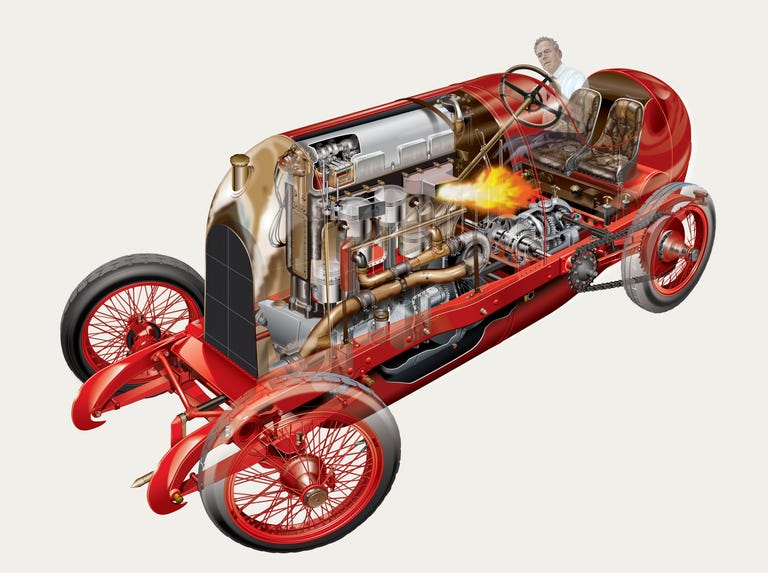
The Fiat S76 was built for one reason: to reclaim the land speed record from the Germans and their "puny" 21.5-liter Blitzen Benz. It is a machine of mechanical violence, a tower of iron and steel that requires three people to start and a driver with nerves of forged steel to pilot. When the engine fires, it doesn’t just run; it erupts. Devoid of a traditional exhaust manifold for much of its life, the S76 spits foot-long tongues of blue and orange flame directly from its ports, accompanied by a percussive roar that can be felt in the marrow of your bones.
The Technical Heart: Engineering a Giant
At the core of the Beast of Turin lies a 28.4-liter (28,353 cc) inline-four engine. In an era before turbocharging or advanced aerodynamics were understood, the primary method for increasing power was simple, "brute-force" displacement. The S76 represents the absolute zenith of this "Giant Era" of engineering.
The engine's architecture is a marvel of Edwardian-era technology. Each of the four cylinders features a staggering 190mm bore and a 250mm stroke. To ensure the massive fuel-air mixture ignited efficiently, Fiat engineers equipped each cylinder with three spark plugs, powered by a low-voltage magneto ignition system. This wasn't just for power; it was a necessity to ensure the flame front could actually travel across the massive combustion chamber in time.
Fiat S76 Technical Specifications
| Feature | Specification |
|---|---|
| Engine Configuration | Inline-4, water-cooled |
| Displacement | 28,353 cc (28.4 Liters) |
| Bore x Stroke | 190 mm x 250 mm |
| Valvetrain | Single Overhead Cam (SOHC), 4 valves per cylinder |
| Ignition | Low-voltage magneto, 3 spark plugs per cylinder |
| Transmission | 4-speed manual, chain drive |
| Power-to-Weight | 176 ps per tonne |
Despite its nearly 30-liter capacity, the car remains surprisingly light by modern standards, tipping the scales at just 1,600 kg. This gives it a power-to-weight ratio of 176 ps per tonne, a figure that remains respectable even today. However, managing that power in 1911 was another matter entirely. The S76 utilizes a massive chain drive to send its 2,000 lb-ft of torque to the rear wheels—a setup that required constant maintenance and carried the constant threat of a snapped chain acting like a whip against the driver's back.
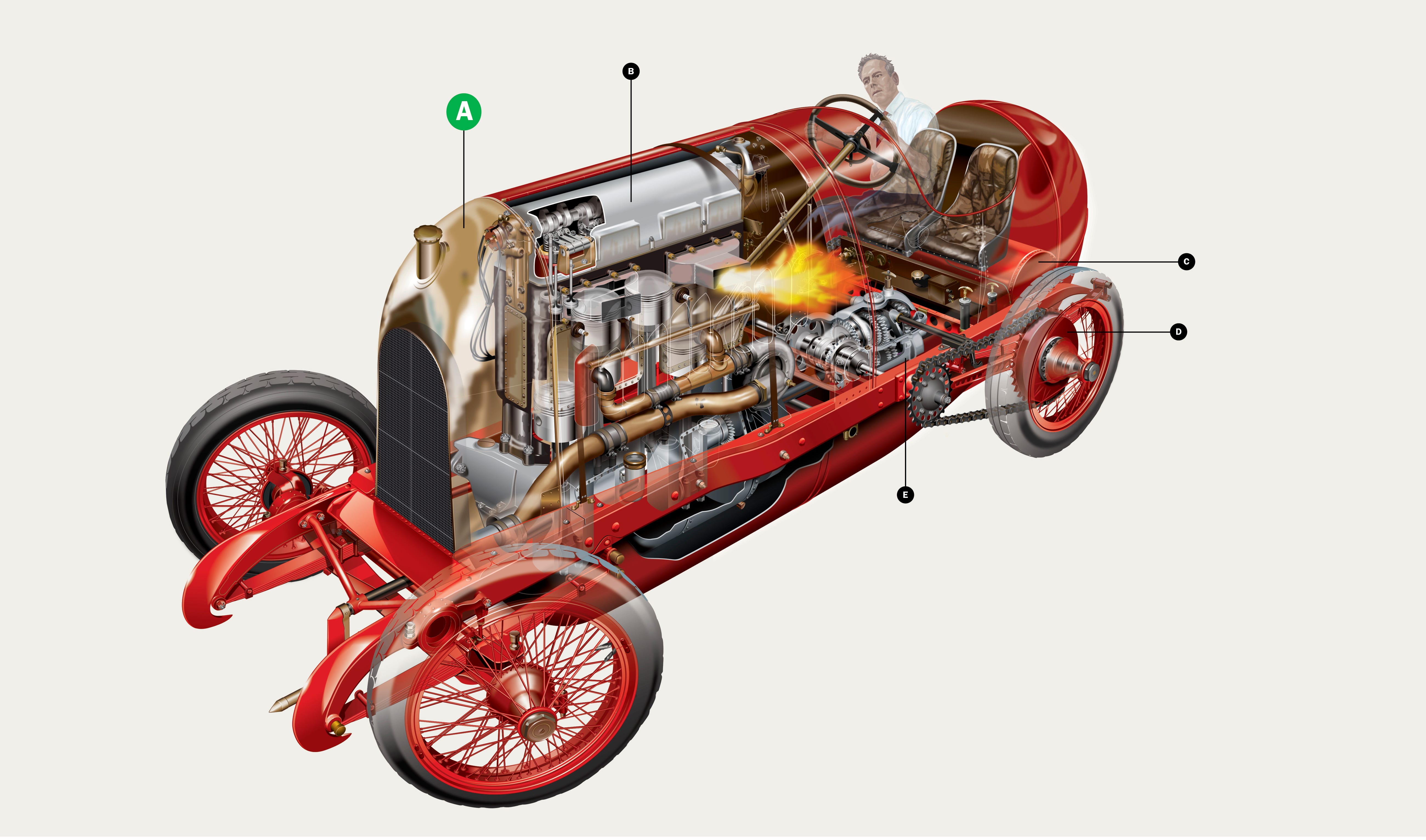
The sheer height of the engine dictated the car's silhouette. The hood sits nearly level with the driver’s head, creating a terrifying "cockpit" where visibility is a secondary concern to the heat and noise radiating from the iron block. There is no firewall in the modern sense; you are sitting inches away from a mechanical volcano.
Chasing the Record: Rivalry and Unofficial Glory
In the early 1910s, the automotive world was obsessed with "The Land Speed Record." Fiat produced only two S76 units. The goal was simple: beat the 125.95 mph record held by the Blitzen Benz.
In 1911, the legendary Italian driver Felice Nazzaro took the wheel of the S76. Despite being one of the greatest racers of his time, Nazzaro allegedly found the car "uncontrollable," a sentiment echoed by many who dared to sit in the high, narrow seat. The car was top-heavy, the steering was heavy, and the rear wheels were prone to spinning at almost any speed.
Nevertheless, the S76 eventually found its way into the hands of Russian Prince Boris Soukhanov. In 1913, at Ostend, Belgium, the car achieved a staggering one-way speed of 132.27 mph (213 km/h). In the eyes of the public, the Beast of Turin was the fastest car in the world. However, the official world record required a two-way run—averaging the speed of two passes in opposite directions to account for wind—to be completed within an hour. The S76 failed to complete the return run due to technical difficulties, meaning its incredible feat remained "unofficial" in the record books.
Decay and Rebirth: The 100-Year Resurrection
Following its racing career and the chaos of World War I, the two S76 chassis met very different fates. One was dismantled by Fiat to prevent rivals from copying its secrets. The second, purchased by Prince Soukhanov, eventually made its way to Australia, where it was crashed, dismantled, and left to rot. For decades, the Beast of Turin was thought to be lost to history, surviving only in grainy black-and-white photographs.
The resurrection began when Duncan Pittaway, an enthusiast with a penchant for Edwardian machinery, discovered the remains of the Soukhanov chassis in Australia. In a stroke of luck, the surviving engine from the dismantled Fiat unit was discovered in Europe. Pittaway spent the next 13 years on a painstaking mission to reunite the two components.
This wasn't a standard restoration; it was an archaeological feat. Many parts, including the radiator, the massive gearbox, and the intricate bodywork, had to be recreated from scratch using original 1911 Fiat blueprints. Pittaway’s dedication paid off in 2014 when the engine fired for the first time in a century.
The "new" Beast of Turin made its public debut at the 2015 Goodwood Festival of Speed. Seeing the car climb the famous hill—belching smoke, spitting fire, and dwarfing modern supercars—was a visceral reminder of what racing used to be. It wasn't about downforce or paddle shifters; it was about a man wrestling a 28-liter monster into submission.
Legacy: Why the S76 Still Matters
The Fiat S76 marks the end of an era. Shortly after its creation, engine technology shifted toward smaller, higher-revving engines with overhead cams and, eventually, superchargers. The "Giant Era"—where displacement was king—faded away as engineers realized that efficiency and lightness were the true keys to speed.
However, the S76 remains the ultimate expression of that period. It represents a time when there were no limits on imagination or scale. Today, we marvel at the S76 not because it is efficient, but because it is absurd. It is a testament to human audacity—the idea that we could take a 28.4-liter engine, bolt it to a chassis with chains, and try to drive it at 130 mph.
Frequently Asked Questions (FAQ)
Why does the Fiat S76 spit fire? The car spits fire primarily because it was designed without a traditional exhaust manifold or muffler. The flames are the result of unburnt fuel and extremely hot exhaust gases exiting the massive 7.1-liter cylinders directly into the atmosphere.
How many Fiat S76 cars exist today? Only one complete Fiat S76 exists today. It was painstakingly restored by Duncan Pittaway using one of the two original chassis and the only surviving 28.4-liter engine.
Is the Fiat S76 road legal? Surprisingly, in the UK, the restored S76 is technically road legal! Duncan Pittaway has famously driven the car to events on public roads, though the lack of lights, windshield, and the tendency to set nearby grass on fire makes it a challenging commuter.
Conclusion
The Fiat S76 "Beast of Turin" is more than just a car; it is a mechanical time capsule. In its 28.4-liter engine, we see the raw ambition of early 20th-century engineering. Thanks to the 13-year devotion of Duncan Pittaway, this fire-spitting monster continues to roam the track, reminding us that sometimes, the most impractical machines are the ones that capture our imagination the most. Whether you are a fan of technical specs or historical drama, the S76 stands as a towering achievement of the "Giant Era" of automotive history.