6,200 pounds of Bavarian steel, glass, and lithium shouldn’t move like a startled gazelle, yet here we are. On paper, the 2026 BMW i7 M70 is a contradiction of terms: a three-ton luxury dreadnought that claims to possess the soul of a sports car. It is the most powerful electric vehicle BMW has ever put into serial production, and after a week of carving through mountain passes and gliding over highway expansion joints, the numbers start to feel like an understatement.
The 2026 BMW i7 M70 produces a staggering 650 horsepower and up to 749 lb-ft of torque in M Sport Boost mode. This enables a 3.1-ton sedan to catapult from 0 to 60 MPH in approximately 3.5 seconds—a feat that defies the traditional laws of momentum. To put that in perspective, this electric titan offers 114 more horsepower and a 0.5-second faster 0-60 time than its gasoline-powered sibling, the 760i xDrive, despite carrying an extra 1,000 pounds of battery weight.
At a Glance: i7 M70 vs. 760i xDrive
| Feature | 2026 BMW i7 M70 | 2026 BMW 760i xDrive |
|---|---|---|
| Powertrain | Dual Electric Motors | 4.4L Twin-Turbo V8 (MHEV) |
| Horsepower | 650 hp | 536 hp |
| Torque | 749 lb-ft (Boost Mode) | 553 lb-ft |
| 0-60 MPH | 3.5 Seconds | 4.0 Seconds |
| Curb Weight | ~6,200 lbs | ~5,100 lbs |
| Base MSRP | ~$168,500 | ~$124,700 |
| Range/Fuel | 268–285 Miles (Electric) | ~20 MPG (Combined) |
Exterior Design: Bold, Brutal, and Polarizing
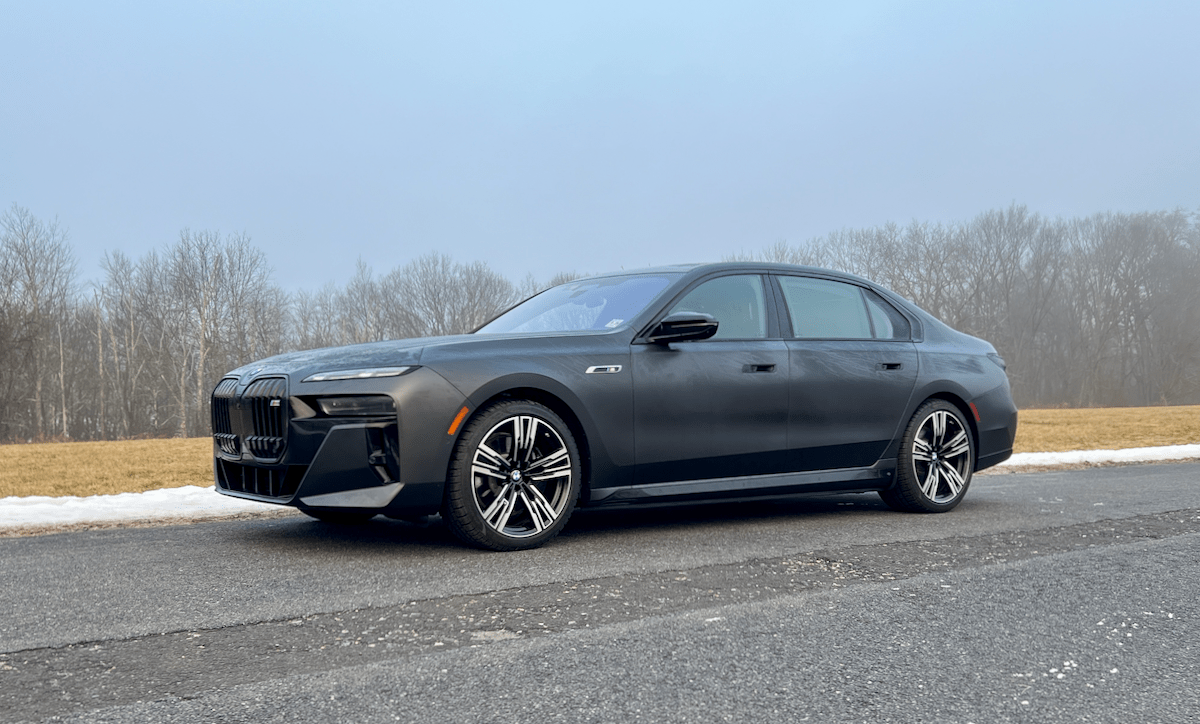
The first thing you notice about the i7 M70 isn’t its length—though at nearly 18 feet, it’s substantial—it’s the sheer verticality of the front fascia. BMW has doubled down on its polarizing design language. The massive kidney grille, now illuminated as standard, is flanked by split LED headlight units that look like narrow, judgmental eyes. In the "Frozen Deep Grey" matte finish of my test car, the i7 M70 looks less like a luxury car and more like a piece of brutalist architecture designed by an aerospace firm.
There is a deliberate lack of "electric" signaling here. Aside from the M70 badges and the absence of tailpipes, it looks almost identical to the standard 7 Series. This is BMW’s strategy: luxury first, electric second. The M-specific side skirts and the high-gloss black accents of the M Performance Professional package add a layer of aggression that helps visually mask the car’s height.
While the looks may remain a "love it or hate it" affair, you don't have to look at the exterior while driving. And once you're behind the wheel, the visual drama is replaced by a sense of absolute mechanical superiority.
Performance: Moving Mountains with 749 lb-ft of Torque
The engineering team at Garching has achieved something remarkable with the i7 M70’s dual-motor setup. The rear motor is the most power-dense unit BMW has ever built, utilizing a unique six-phase design that allows it to maintain peak power through the top end of the rev range—a common weak point for many EVs.
In real-world driving, the torque delivery is nothing short of tectonic. Despite its 3.1-ton curb weight, the i7 M70's setup generates enough low-end grunt to move 8.27 pounds per lb-ft of torque. For context, that’s better low-end pull than many traditional dedicated sports cars. When you pull the "Boost" paddle on the left side of the steering wheel, the car tightens its grip, the Hans Zimmer-composed "IconicSounds" swell in the cabin, and the horizon simply arrives.
But it’s the handling that truly boggles the mind. BMW has equipped the M70 with every piece of chassis wizardry in their arsenal:
- Active Roll Stabilization: This system uses 48-volt electric motors to counter body roll, keeping the car eerily flat during high-speed cornering.
- Rear-Axle Steering: By turning the rear wheels up to 3.5 degrees, the i7 M70 feels significantly shorter than it is, allowing for a turning circle that rivals a 3 Series.
- M-Specific Air Suspension: It manages to be both supple and supportive, though you can never quite forget the sheer mass you're managing when you hit a mid-corner bump.
The transition from regenerative to friction braking is nearly seamless, a feat few manufacturers have perfected. However, the sheer momentum of 6,200 pounds means you’ll want to plan your braking points if you're pushing hard on a canyon road.
The 'Bank Vault' Experience: Interior and Ride Quality
If the performance is physics-defying, the interior is sanctuary-defining. The cabin of the i7 M70 is perhaps the quietest electric car I've tested for the 2026 model year. BMW has gone to extreme lengths to isolate NVH (Noise, Vibration, Harshness), including foam-filled tires and specific acoustic glazing.
The ride quality, courtesy of the standard adaptive two-axle air suspension, makes road imperfections disappear entirely. It doesn’t just "soak up" bumps; it deletes them. The seats, finished in a mix of leather and cashmere-wool, are more akin to high-end lounge chairs than automotive buckets.
Logan’s Insight: If you’re looking for the "BMW feel," it’s here, but it’s been translated into the language of luxury. The steering is precise but light, and the silence is so profound it feels like sitting in a bank vault at the bottom of the ocean.
Tech Overload: From the Cockpit to the Theater Screen
The dashboard is dominated by the BMW Curved Display, running iDrive 8.5 (or 9.0 in later 2026 builds). It’s a visual masterpiece, though the lack of physical buttons for the climate control remains a point of contention for those of us who prefer haptic feedback over screen-tapping.
However, the real showstopper is in the back. The optional 31-inch BMW Theater Screen drops from the ceiling, offering 8K resolution and integrated Amazon Fire TV. Coupled with the Bowers & Wilkins Diamond Surround Sound System, the rear seat becomes a mobile cinema. Small touchscreens integrated into the door panels allow passengers to control everything from the "Executive Lounge" seat recline to the motorized window shades.
Range, Charging, and Real-World Efficiency
Range is the one area where the i7 M70 pays a slight tax for its performance. The estimated driving range for the 2026 BMW i7 M70 is between 268 and 285 miles, depending on your choice of wheels (the 21-inch wheels look better but bite into the mileage).
In my testing, which included a mix of spirited mountain driving and highway cruising, the range was closer to the 270-mile mark. While this isn’t class-leading—Lucid still holds that crown—BMW makes up for it with a consistent charging curve. Using a DC Fast Charger, you can add roughly 80 miles of range in just 10 minutes.
- 10% to 80% charge: Approximately 34 minutes under optimal conditions.
- Home charging: A standard 11kW Level 2 charger will top the battery from empty in about 10 hours.
The Multi-Thousand Dollar Question: i7 M70 vs. 760i xDrive
Deciding between the electric i7 M70 and the gas-powered 760i xDrive comes down to more than just a preference for fuel type. The i7 M70 carries a $43,800 price premium over the 760i xDrive, representing a roughly 35% increase in base MSRP.
Is it worth it? From a performance standpoint, the answer is a resounding yes. The instant torque of the electric motors provides a level of effortless passing power that even the excellent twin-turbo V8 can't match. Furthermore, the i7’s lower center of gravity (due to the floor-mounted battery) makes it feel more planted. However, if you are a long-distance road-tripper who doesn't want to plan stops around charging infrastructure, the 760i remains the pragmatic choice.
Verdict: The Ultimate Luxury EV for those who want Everything
The 2026 BMW i7 M70 is a masterpiece of engineering that shouldn't make sense but does. It is a three-ton sedan that handles with the grace of a car two-thirds its size, while offering an interior experience that rivals Rolls-Royce.
It is designed for the tech-forward executive or the BMW loyalist who wants the absolute peak of the brand's current capabilities. It isn't just an "electric 7 Series"—it is the definitive 7 Series. While the styling may be a hurdle for some, the experience from the driver’s seat (or the theater-like rear seat) is enough to convert even the most die-hard internal combustion enthusiast.
FAQ
What is the real-world range of the 2026 BMW i7 M70? While the EPA estimate is between 268 and 285 miles, real-world range typically lands around 270 miles depending on wheel size and driving style. Cold weather and frequent use of "Boost Mode" will decrease this range.
How does the i7 M70 compare to the Mercedes-AMG EQS? The i7 M70 offers a more traditional "three-box" sedan silhouette and a significantly more luxurious rear-seat experience (including the Theater Screen). The EQS focus is on aerodynamics and futuristic "Hyperscreen" tech, but the i7 M70 generally delivers a more composed, traditional luxury ride.
Does the i7 M70 come with free charging? Yes, for 2026, BMW typically includes three years of complimentary 30-minute charging sessions at Electrify America stations for the original owner.
Is the i7 M70 faster than the gas-powered M7? BMW does not currently make a dedicated "M7." The i7 M70 serves as the performance flagship of the 7 Series lineup, and with its 3.5-second 0-60 time, it is the quickest 7 Series currently in production.