Taking a massive full-size truck onto technical rock crawling trails usually ends in one of two ways: expensive body damage or total frustration. In a world where the Jeep Wrangler and Toyota Tacoma reign supreme due to their nimble dimensions, the second-generation Toyota Tundra is often dismissed as a "mall crawler" or a dedicated tow rig. However, Kai from Tinkerer’s Adventure decided to challenge this status quo with his 2007 Tundra Regular Cab project. His mission wasn't just to build a capable off-roader, but to do so using an "OEM-Plus" philosophy—maximizing performance through factory-engineered components to ensure reliability that aftermarket "bolt-ons" often compromise.
The result is a vehicle that defies conventional off-road logic. It’s a full-size beast that navigates tight switchbacks and jagged rock gardens with the poise of a vehicle half its size. By focusing on engineering logic rather than aesthetics, this Tundra proves that you don't need a six-inch bracket lift or a sawzall to fit 37-inch tires and conquer the hardest trails in the West.
The 37-Inch Tire Secret: No Body Mount Chop Required
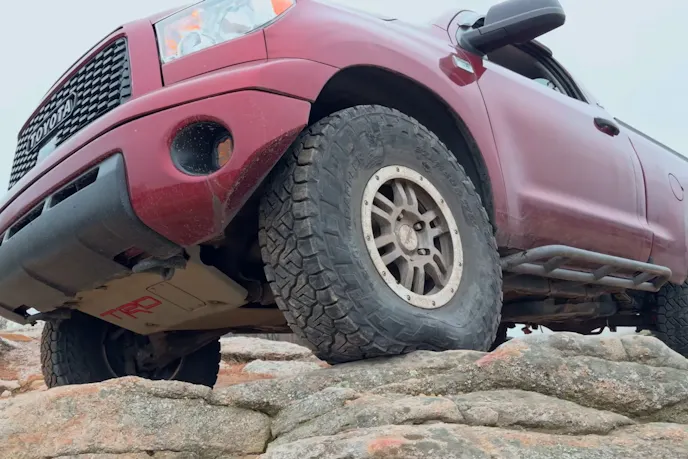
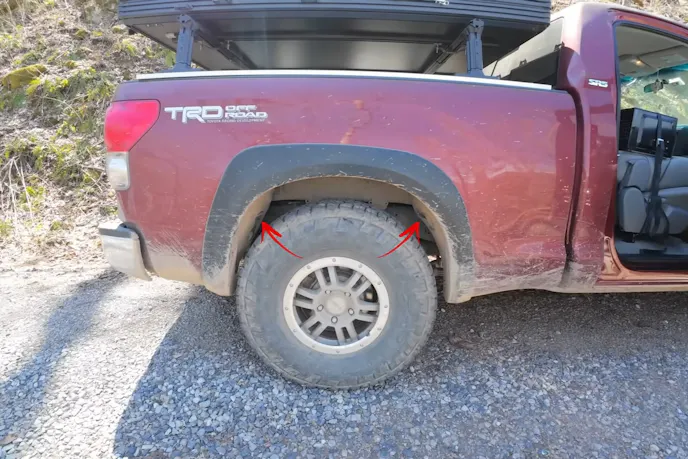
In the Toyota community, fitting 35-inch tires usually requires the dreaded "Body Mount Chop" (BMC). Stepping up to 37s generally necessitates aggressive clearancing, high-clearance fenders, and significant structural modification. Yet, this Tundra runs 37-inch Nitto Recon Grapplers with zero structural cutting to the frame or body mounts.
The Secret to 37s: To fit 37-inch tires on a second-gen Tundra without a body mount chop, use forged 17-inch TRD Rock Warrior wheels with a 50mm offset and perform minor rear wheel well modifications.
The "magic" lies in the geometry. Most aftermarket wheels feature a low or negative offset to provide a wide, aggressive stance. While this looks "cool," it pushes the tire’s scrub radius outward, causing the rubber to swing into the body mount and fenders during turns. The factory TRD Rock Warrior wheels—specifically designed for the Tundra—feature a +50mm offset. This keeps the tire tucked further into the wheel well, allowing it to pivot closer to the center of the steering axis.
By pairing these forged wheels with 37x12.50R17 Nitto Recon Grapplers, the build achieves 100% tire clearance. The only modifications required were the removal of a small plastic bracket in the rear of the front wheel well and some minor trimming of the plastic liner. This setup preserves the structural integrity of the truck while providing the massive ground clearance and "footprint" required for technical crawling.
Unlocking Hidden Suspension Travel
A common mistake in Tundra builds is installing stiff, high-lift springs that actually reduce downward suspension travel (droop) in exchange for height. For rock crawling, articulation is more valuable than height. Kai’s approach focused on maximizing the Independent Front Suspension (IFS) through factory-validated parts.
Suspension Logic: A Toyota Tundra's independent front suspension (IFS) travel can be increased by nearly 2 inches by swapping stock shocks for OEM TRD Pro internal bypass units.
The transition to OEM TRD Pro internal bypass units (sourced from a newer model Tundra) resulted in an immediate 1.9-inch increase in usable vertical wheel travel. Unlike standard shocks, internal bypass units allow for softer damping at the ride-height "zone" for street comfort, while getting progressively firmer at the ends of the stroke to prevent bottoming out on the trail.
To balance this increased front flex, the rear suspension was kept relatively simple but effective. A rear sway bar was added—not for stiffness, but positioned behind the axle to maintain road manners during high-speed transit while allowing the leaf springs to move independently when twisted over rocks. This combination ensures the truck doesn't feel like a "wet noodle" on the highway but remains "limber" enough to keep all four tires in contact with the ground on uneven terrain.
Tactical Armor: Minimum Effort, Maximum Protection
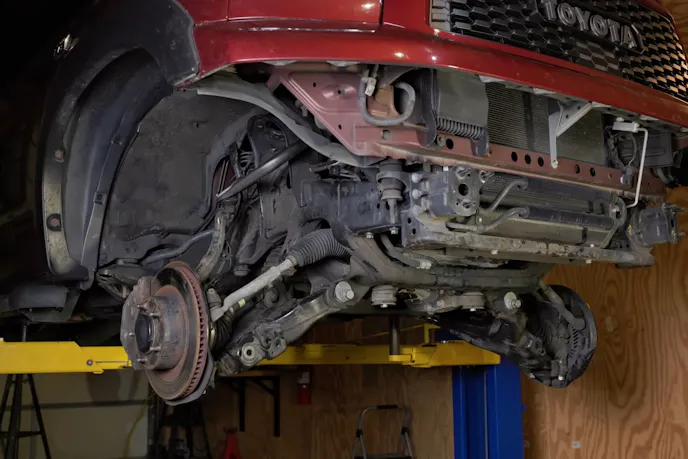
When you look at this Tundra, it doesn't scream "off-road warrior." It looks like a clean, well-maintained factory truck. This is the "Sleeper" effect of the OEM-Plus philosophy. Instead of dropping $3,000 on a heavy steel plate bumper that would kill the truck's fuel economy and front-end geometry, the factory steel bumper was modified.
By carefully cutting the lower corners of the factory chrome bumper, the approach angle was significantly improved. To keep the finish looking professional, custom steel "caps" were welded onto the cut ends and painted to match. It’s a modification that costs next to nothing but provides the clearance needed to point the 37s at a vertical ledge without smashing the chrome.
The protection suite is rounded out by:
- TRD Pro Skid Plates: Factory-engineered aluminum plates that offer high strength-to-weight ratios.
- Custom 'Trail-Gear' Sliders: Adapted to fit the Regular Cab frame, providing essential rocker protection against "pivot" maneuvers on rocks.
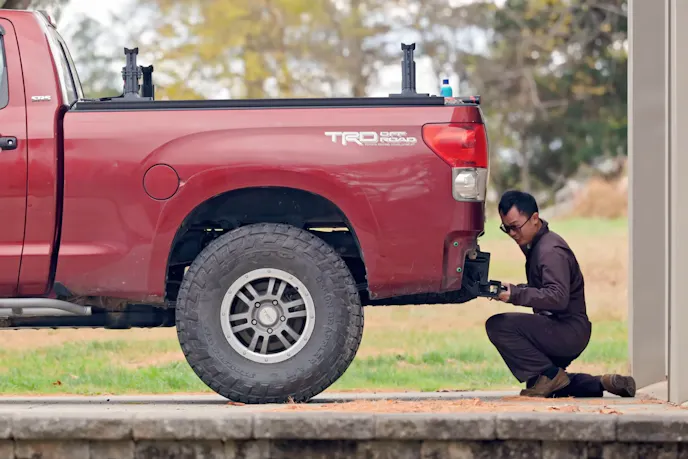
- Hitch Removal: The heavy factory tow hitch was removed to gain several inches of departure angle, preventing the rear end from "dragging" when coming off obstacles.
The OEM-Plus Philosophy: Why Reliability Wins
In the off-road world, there is a constant battle between "capability" and "reliability." The more you modify a vehicle with non-factory parts, the more you introduce potential points of failure. This Tundra triumphs because it respects the original engineering.
Defining OEM-Plus: The OEM-plus philosophy in off-roading involves upgrading a vehicle for higher performance using factory-engineered parts to ensure maximum reliability, lower maintenance, and on-brand styling.
By using the TRD Rock Warrior wheels, TRD Pro suspension, and factory bumpers, this truck retains the "painless" daily driving experience of a stock Tundra. There are no weird vibrations, no squeaky aftermarket bushings, and no constant need for re-alignment. Perhaps most importantly, the build was designed to retain a full-size 37-inch spare tire in the factory under-bed location—a feat almost unheard of in the Tundra community, achieved through clever heat-shield modification and precise tire placement.
The Budget Breakdown: Pro-Level Capability for $21k
One of the most impressive aspects of this project is the value proposition. In an era where "overland" builds easily clear $100,000, this Tundra provides world-class capability for a fraction of that cost. By starting with a high-mileage but well-maintained 2007 Regular Cab, the foundation was affordable, leaving more room for the right modifications.
| Item | Cost (Estimated) |
|---|---|
| 2007 Tundra Regular Cab (130k miles) | $15,000 |
| TRD Pro Internal Bypass Shocks | $1,200 |
| Nitto Recon Grappler 37" Tires (x5) | $2,450 |
| TRD Rock Warrior Forged Wheels (Used) | $800 |
| Armor (Sliders & Skid Plates) | $1,100 |
| Bumper/Fender Modifications | $554 |
| Total Build Cost | $21,104 |
For just over $21,000, this Tundra can follow a $70,000 Jeep Rubicon through technical trails while offering the comfort, payload, and legendary 5.7L V8 reliability of a Toyota truck.
Conclusion: The New Standard for Full-Size Crawlers
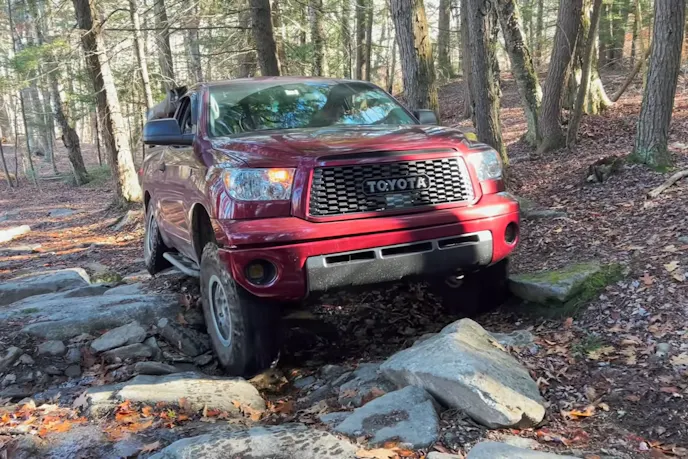
The success of this custom Rock Warrior Tundra lies in its restraint. It doesn't use a massive lift to clear tires; it uses the correct wheel offset. It doesn't use generic aftermarket shocks; it uses tuned bypass units from the factory's highest trim level.
This Tundra is a masterclass in "engineering logic." It proves that the second-gen Tundra platform—especially in the rare regular cab, short-bed configuration—is a sleeping giant in the rock crawling world. By adhering to the OEM-plus philosophy, Kai has created a vehicle that is just as comfortable cruising at 80 mph on the interstate as it is crawling over granite boulders in the Sierra Nevada.
FAQ
Q: Do 37-inch tires affect the Tundra’s fuel economy significantly? A: Yes. Moving to 37s increases rotational mass and aerodynamic drag. Expect a 2-3 MPG drop compared to stock, though the Nitto Recon Grapplers are lighter than many dedicated Mud-Terrains, which helps mitigate the loss.
Q: Why choose the Regular Cab over the Double Cab or CrewMax? A: For rock crawling, wheelbase is everything. The Regular Cab Short Bed (RCSB) has a much shorter wheelbase and better "breakover angle," meaning it is far less likely to get high-centered on peaks or stuck in tight turns where longer trucks would have to perform 3-point turns.
Q: Is the stock 5.7L V8 powerful enough for 37s without re-gearing? A: While the 5.7L has plenty of torque, re-gearing to 4.88 or 5.29 is highly recommended for 37-inch tires to restore factory acceleration and reduce strain on the transmission, especially if you plan on towing.
Are you ready to rethink your off-road build? Whether you're driving a Tundra or a Tacoma, focusing on wheel geometry and factory-validated parts is the fastest way to trail success without the maintenance headaches. Keep it clean, keep it functional, and keep it OEM-Plus.