In the automotive world, five billion years from now, the sun will likely expand into a red giant and swallow the Earth. In that cosmic endgame, as the last of the oceans boil away, there is a distinct possibility that the Karma Revero—in some form or another—will still be rolling off an assembly line, its voluptuous curves shimmering under the dying light of a doomed star. It is the car that refuses to die, a four-wheeled rebellion against the relentless march of "disruptive" EV startups and the cold efficiency of German engineering.
Born from the ashes of the original 2012 Fisker Karma, the Revero has undergone a metamorphosis that would make a soap opera writer blush. It has survived bankruptcy, a brand renaming, multiple ownership changes, and the shift from General Motors power to BMW internals. Yet, here we are in 2025, and the Revero remains one of the most striking objects on the road. The central question for the modern enthusiast, however, is whether a thirteen-year-old aesthetic and a $125,599 starting MSRP can justify itself in an era of 500-mile ranges and autonomous driving suites. As tested, our review unit topped out at a staggering $168,499.
The Design: A Timeless Silhouette or an Aging Icon?
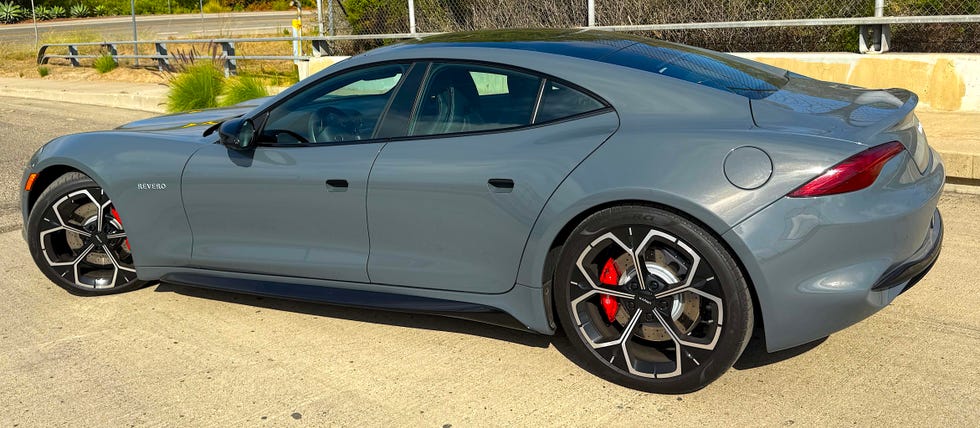
Seen through an extremely narrow lens, the Karma Revero is perhaps the most beautiful sedan ever produced. Designed by the legendary Henrik Fisker, its proportions are less "family car" and more "predatory animal." It sits impossibly low to the ground, with a narrow waist and hips so flared they make a Porsche Taycan look modest. Even in 2025, the Revero looks more like a high-concept sketch brought to life than a mass-market vehicle.
When you park a Revero next to a Tesla Model S or even a Lucid Air, the difference in design philosophy is jarring. The Lucid is a masterclass in interior packaging and aerodynamic efficiency; it is a "smart" car. The Revero, by contrast, is an "emotional" car. It doesn't care about your drag coefficient as much as it cares about how you look reflecting off a glass-fronted boutique in Beverly Hills.
Why the Design Still Works:
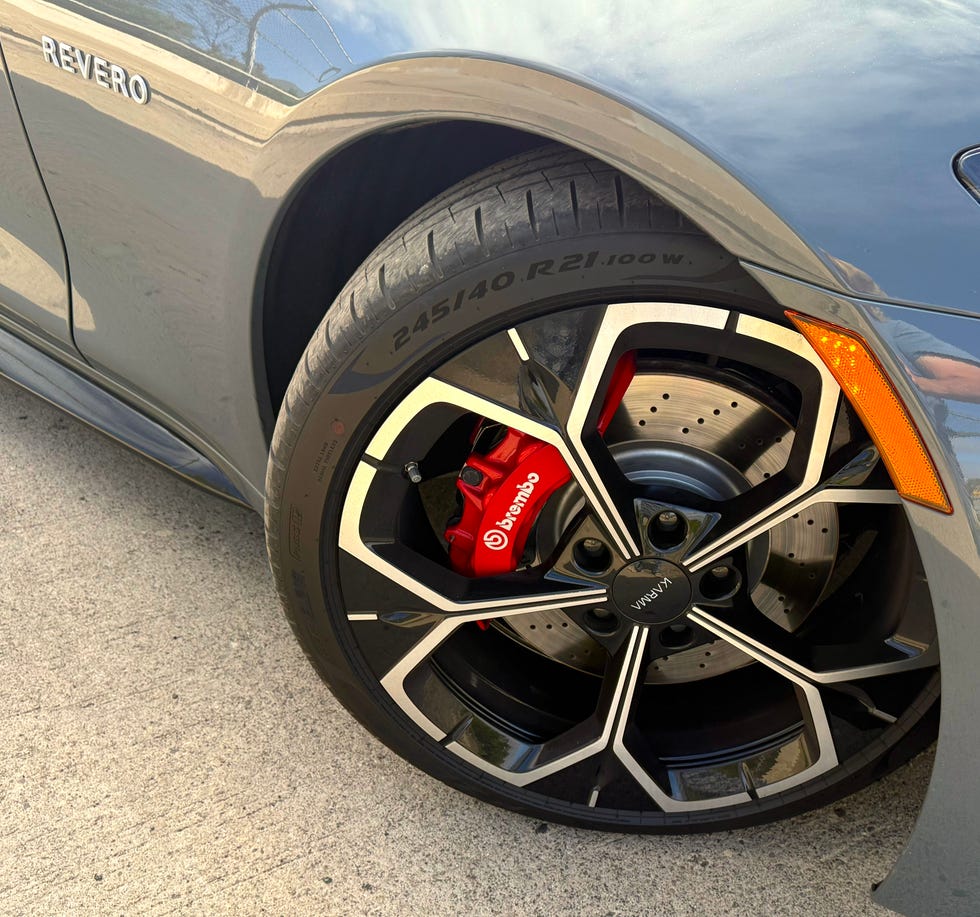
- The Exotic Stance: Its low roofline and massive 21- or 22-inch wheels create a profile that screams "exotic" in a way no traditional luxury sedan can match.
- Novelty Factor: Because Karma produces these in relatively low volumes, the Revero retains a sense of exclusivity that has long since evaporated from the ubiquitous Tesla fleet.
- Persistent Modernity: Curiously, because the design was so far ahead of its time in 2012, it doesn't feel "old" so much as it feels "alternative."
Powertrain & Performance: BMW DNA and the "Sport Mode" Drama
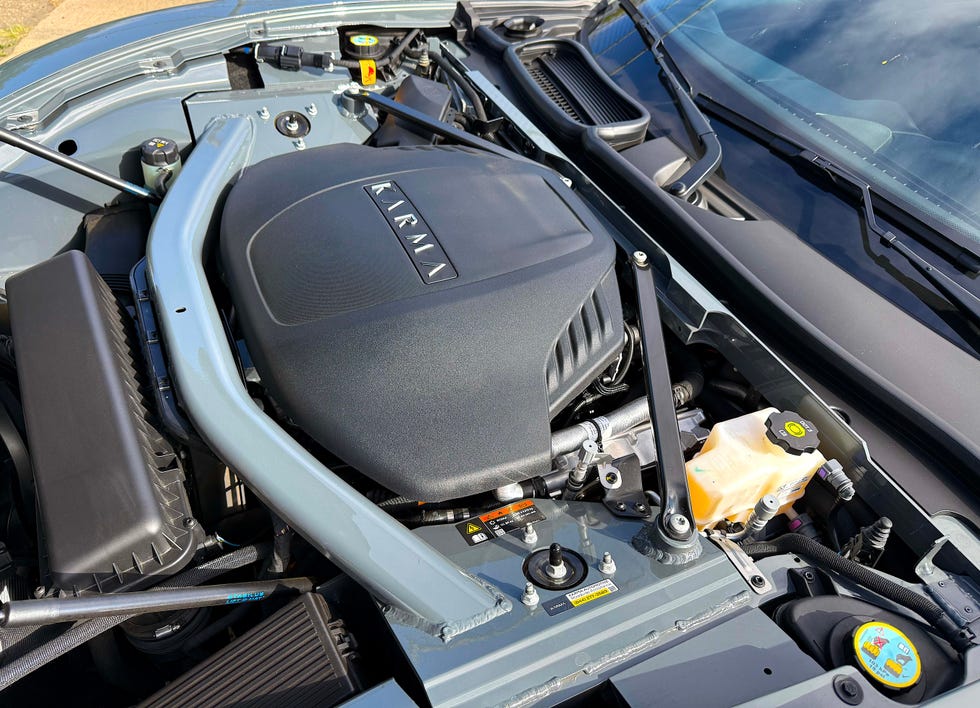
One of the most frequent questions potential buyers ask is: Does the Karma Revero still use a Fisker engine? The answer is a definitive no. The modern Karma Revero has long since ditched the clunky, noisy General Motors Ecotec engine of the original Fisker. In its place sits a much more refined, BMW-sourced 1.5-liter turbocharged inline-three engine.
This engine doesn't drive the wheels; it acts as an onboard generator, feeding a 28.0-kWh lithium-ion battery pack which, in turn, powers two electric motors at the rear. The total output is a formidable 536 horsepower and 550 lb-ft of torque.
Real-World Performance Metrics
In our long-term testing, the Revero proved it could still hold its own in a sprint. In "Sport Mode," which engages both the battery and the generator for maximum thrust, the Revero achieves:
- 0-60 mph: 4.1 seconds.
- Quarter-Mile: 12.4 seconds at 114 mph.
While these numbers are impressive, the experience of that performance is a mixed bag. When you bury the throttle, the BMW three-cylinder kicks in with a noticeable "whoosh" and a low-frequency buzzing drone. It isn't the soulful roar of a V8, nor is it the eerie silence of a pure EV. It feels industrial—a reminder that there is a small, hard-working engine beneath that long hood doing its best to keep up with your right foot.
Expert Tip: If you value silence, stay in "Stealth Mode." The car is a serene cruiser until the battery dips below a certain threshold, at which point the generator awakens to preserve the remaining charge.
Range and Efficiency: Reality vs. Claims
Karma markets the Revero as a grand tourer that offers the best of both worlds: electric commuting and gasoline-powered freedom. However, our long-term testing revealed a significant gap between the marketing brochure and the highway reality.
What is the real-world electric range of the Karma Revero? While Karma claims up to 80 miles of battery-only range, our real-world highway testing at sustained speeds of 70–80 mph resulted in approximately 45 to 50 miles of range in Stealth mode. For most daily commutes, 50 miles is perfectly adequate, but it falls short of the "class-leading" claims often touted by the brand.
Once the battery is depleted, the car switches to "Sustain Mode," where the 1.5L engine maintains the battery level. In this mode, the Revero essentially becomes a traditional hybrid, though a heavy one.
The Packaging Disaster: Interior and Utility
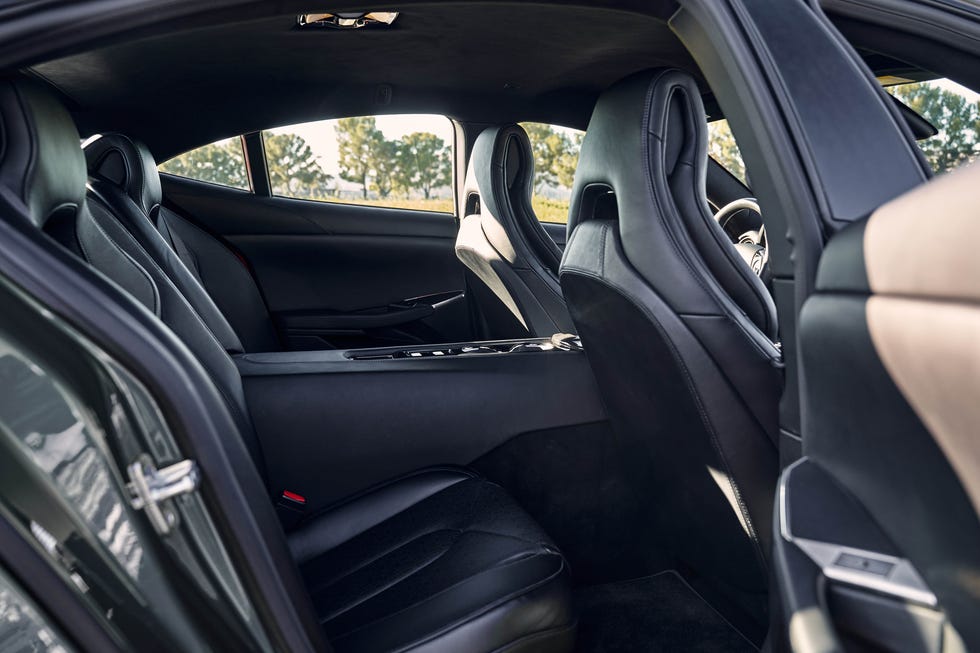
If the exterior of the Revero is a triumph of art, the interior is a cautionary tale regarding "packaging." This is where the 2012 architecture truly shows its age. To put it bluntly, the Karma Revero is a massive car on the outside with the interior space of a compact coupe.
Consider this statistic: The 2025 Karma Revero features a 124.4-inch wheelbase, making it nearly 8 inches longer than the Lucid Air. Yet, while the Lucid Air feels like a cavernous lounge, the Revero feels like a cockpit. The massive center tunnel—which houses the battery pack—runs the entire length of the cabin, effectively bisecting the interior and creating a "cozy" (read: cramped) environment for four adults.
The Trunk Space Problem
Then there is the cargo capacity. How much trunk space does the Karma Revero have? The answer is a meager 6.4 cubic feet. To put that in perspective, a Mazda Miata—a tiny two-seat roadster—has about 4.6 cubic feet. You are getting a sedan that is over 196 inches long, yet it has only about 2 cubic feet more storage than a car that could practically fit in its shadow.
Pros of the Interior:
- High-quality bridge-of-weir leather and sustainable wood trim.
- Updated digital instrument cluster that looks modern.
- A tactile sense of craftsmanship that feels "hand-built."
Cons of the Interior:
- Rear seat accessibility is a genuine struggle for anyone over six feet.
- The infotainment system, while improved, lacks the snappiness of Tesla’s V11 software or Porsche’s PCM.
- Almost non-existent small-item storage (the "coin holders" feel like relics of a bygone era).
Competitive Landscape: Who is the Karma For?
At a tested price of $168,000, the Revero enters a gladiatorial arena against the Porsche Taycan Turbo, the Lucid Air Grand Touring, and the high-end Mercedes-Benz EQS.
| Feature | Karma Revero | Porsche Taycan 4S | Lucid Air Grand Touring |
|---|---|---|---|
| Powertrain | Plug-in Hybrid (EREV) | Battery Electric (BEV) | Battery Electric (BEV) |
| 0-60 MPH | 4.1 Seconds | 3.5 Seconds | 3.0 Seconds |
| Electric Range | ~50 Miles (Real-world) | ~230-280 Miles | 512 Miles |
| Starting Price | $125,599 | ~ $118,000 | ~ $110,000 |
| Wheelbase | 124.4 Inches | 114.2 Inches | 116.5 Inches |
On paper, the Revero loses almost every objective battle. It’s slower than the Lucid, has less range than the Porsche, and costs more than both when similarly equipped. However, Karma isn't selling a "logical daily driver." They are selling a statement. For those who don't want to be the fifth person at the charging station with a white Model S, the Revero offers a level of exclusivity that is becoming increasingly rare.
For those hesitant about the $125k+ commitment, the "Engage by Karma" subscription model has emerged as an intriguing alternative, allowing drivers to experience the car's eccentricities without the long-term burden of depreciation.
Conclusion: A Vote for Eccentricity
The 2025 Karma Revero is a magnificent contradiction. It is a "packaging disaster" that happens to be one of the most beautiful cars on the road. It uses a BMW three-cylinder engine to act as a heart for a design that debuted when the iPhone 5 was new. It is expensive, impractical, and occasionally unrefined.
And yet, every time you walk toward it in a parking lot, you'll forgive its 6.4 cubic-foot trunk. Every time a passerby stops to ask "What is that?", you'll forget that a Lucid Air is faster. The Revero is for the buyer who values the "soul" of a design over the efficiency of its transistors. Is a 13-year-old design still worth $125,000? If you view a car as a tool, the answer is no. If you view a car as a piece of kinetic art, the Revero remains in a class of its own.

FAQ
Does the Karma Revero require premium gasoline?
Yes. Because the BMW-sourced 1.5L turbocharged engine is a high-compression unit used as a generator, Karma recommends 91 octane or higher to ensure longevity and efficiency of the range-extending system.
How long does it take to charge the Karma Revero?
Using a Level 2 (240V) charger, the Revero's 28.0-kWh battery can be fully replenished in about 4 hours. It also supports DC fast charging (up to 45kW), which can bring the battery from 5% to 80% in approximately 34 minutes.
Can the Karma Revero drive if the battery is completely dead?
Yes. As long as there is gasoline in the tank, the internal combustion generator will provide power to the electric motors. However, performance may be slightly reduced compared to when the battery has a full "buffer" for Sport Mode.